Rare Earth Oxide Suppliers: Purity and Particle Size Audit
Evaluating Framework
A rare earth oxide catalogue entry answers one question well: what the compound is. It leaves two harder questions open: whether the supplier can hold a purity limit, and whether it can reproduce a particle size band batch after batch. Those two capabilities decide whether your polishing, catalyst, or optical glass process behaves predictably.
This guide sets out a five-layer framework for auditing rare earth oxide suppliers, using Large Particle Size Cerium Oxide and high-purity oxide grades as the working examples. Every statement about Sichuan Wonaixi New Materials Technology Co., Ltd. (WONAIXI) comes from the company's published product, certification, and capability information. Where a claim can only be confirmed by documents the buyer must request, that is stated explicitly rather than assumed.
Why "Large Particle Size" and "High Purity" Are Not Specifications Yet
A catalogue description is an identity record, not an acceptance criterion. WONAIXI's product data for Large Particle Size Cerium Oxide lists the formula CeO2, CAS 1306-38-3 and a molecular weight of 172.12, and describes the material's role as a glass decolorizer, a glass polishing agent, and a raw material for preparing cerium metal. The same listing notes that high purity cerium oxide has important applications in rare earth luminescent materials.
None of those lines defines a numeric particle size band, an assay floor, or a test method. That is a property of rare earth catalogues in general rather than a fault in this one. In the public evidence reviewed for this guide, no independently verified purity, impurity, or particle size distribution data was available for the listed compounds, and product names alone do not establish interchangeability between suppliers or grades.
Industry Background: Why Oxide Verification Is Now a Commercial Issue
Three developments make supplier verification more consequential than it was a decade ago.
1. Value sits in the physical specification, not in the metal. The light rare earth oxides used for polishing, decolorizing, and catalysis trade at very different values from magnet-grade material. USGS reports an average price of approximately USD 1.00 per kilogram for Lanthanum Oxide (99.5% min) in early 2026, while the SMM benchmark for praseodymium-neodymium (NdPr) mixed oxide reached 738,000 CNY per tonne as of September 2026. For light oxides, the price per kilogram is low, which means the engineering value of a batch is carried by particle size distribution, purity, and consistency rather than by metal content. Buying on price alone in this segment usually transfers the risk to your production line.
2. Demand keeps expanding. Grand View Research estimates the global rare earth elements market at USD 4.5 billion for 2026. Growth in polishing, catalyst, and electronics applications keeps the pool of qualifying suppliers relevant to procurement teams.
3. Export controls now sit inside supplier capability. China's Ministry of Commerce and the General Administration of Customs established export-control requirements for certain rare earth elements and their products, including oxides, compounds, and mixtures, effective 2025-04-04 under Announcement No. 18 of 2025. Exporters of controlled items must identify them in customs declarations and provide the applicable dual-use item control number where relevant, and customs may hold goods while queries are resolved. Supplier capability therefore now includes licence and declaration readiness, not production capability alone. Applicability must be checked product by product and element by element against the controlled-item list: the announcements establish the framework, but they do not by themselves prove that a specific grade is controlled.
What the Catalogue Does Confirm About WONAIXI
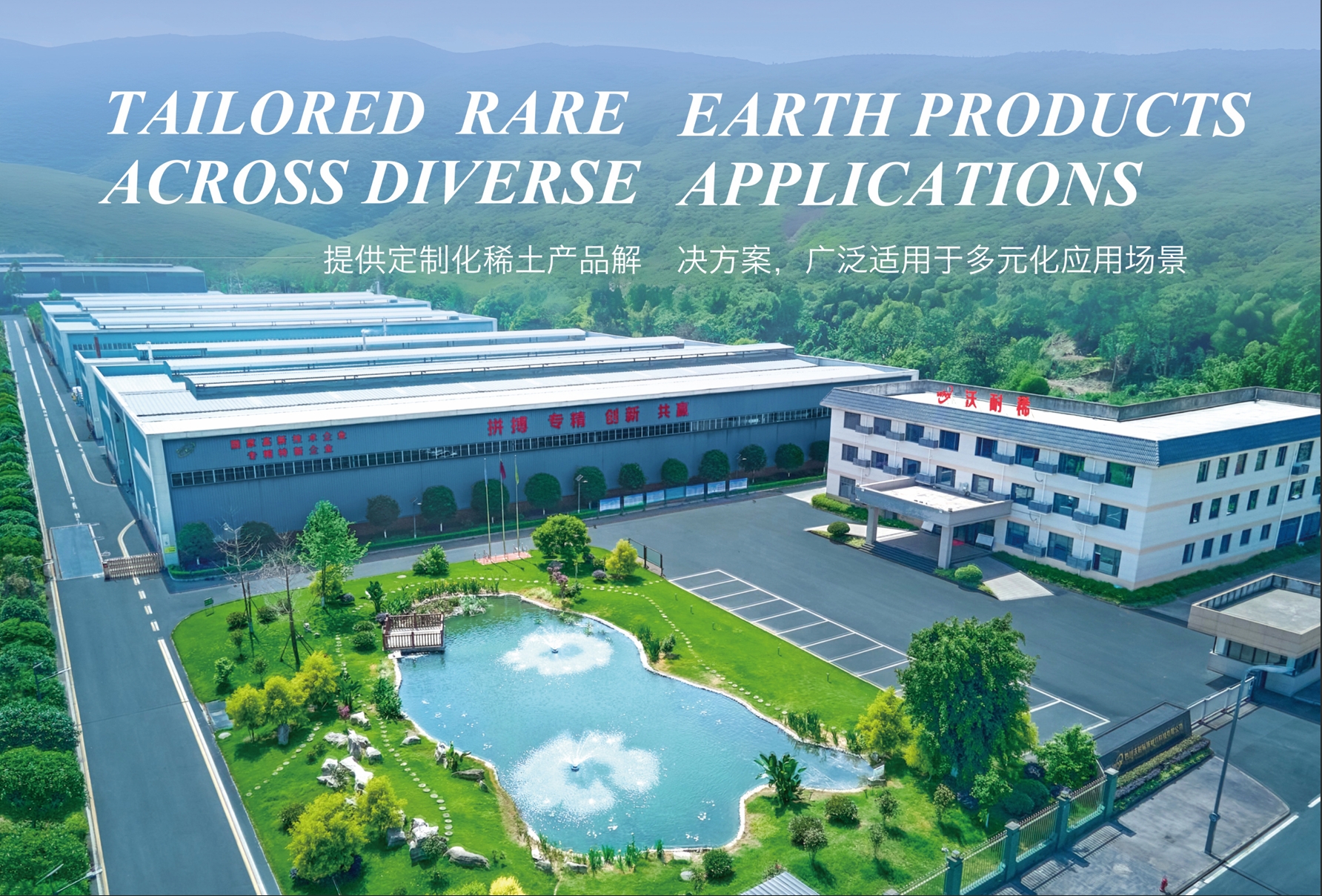
WONAIXI, formally Sichuan Wonaixi New Materials Technology Co., Ltd., is a rare earth functional materials manufacturer founded in 2012 and based in the Shawan Economic Development Zone, Leshan City, Sichuan Province, China. Its published profile states a plant area of 46,667 m2, approximately 98 employees, and an R&D group of 12 engineers, and identifies the company as a National High-Tech Enterprise and a Sichuan Provincial SRDI Enterprise.
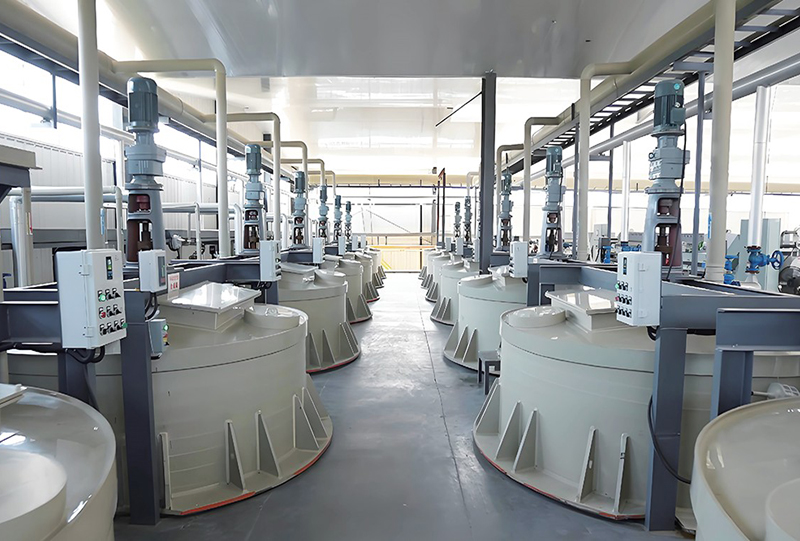
- Capacity and range: annual production capacity of 15,000 tons of high-purity rare earth salts and 3,000 tons of high-precision rare earth polishing powder, spanning nine major rare earth product categories and more than 50 refined specifications.
- Oxide grades: the company reports producing catalyst-grade Cerium Oxide and high-purity Lanthanum Oxide (99.9%) for optical glass, alongside the Large Particle Size Cerium Oxide grade listed in its catalogue.
- Stated oxide identities: Cerium Oxide and Large Particle Size Cerium Oxide, both CeO2, CAS 1306-38-3, molecular weight 172.12, used as a glass decolorizer, a glass polishing agent, and a precursor for cerium metal; Lanthanum Oxide, La2O3, CAS 1312-81-8, molecular weight 325.8, described for use in the glass, ceramic, and electronics industries.
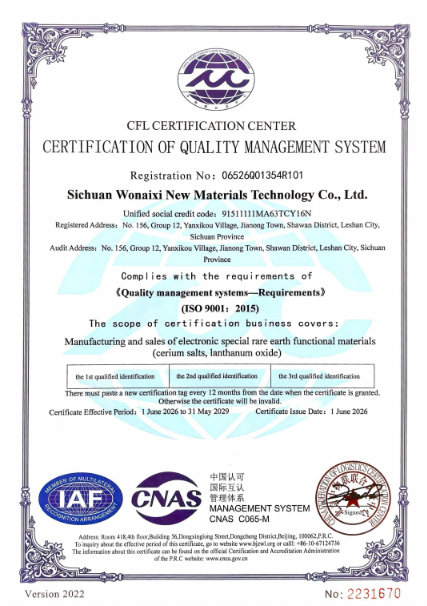
- Quality system: 100% testing is stated as the quality control method, and the company holds ISO 9001 certification issued under certificate number 06526Q01354R101 by the CFL Certification Center (Beijing China Logistics Joint Certification Center) against GB/T19001-2016 / ISO 9001:2015, valid from 2026-06-01 to 2029-05-31, with a scope covering the manufacturing and sales of electronic special rare earth functional materials (cerium salts, lanthanum oxide).
- Customization: OEM and ODM production services with customization of indicators, contents, specifications, purity, and packaging.
- Commercial frame: lead time of 30-45 days, MOQ communicated according to the actual situation, FOB/CIF delivery terms, pre-shipment test as the acceptance criterion, and payment by bank transfer, Western Union, or PayPal with 30% deposit in advance and 70% balance against the copy of the bill of lading.
The catalogue also extends well beyond oxides. It lists hexahydrate neodymium nitrate (Nd(NO3)3.6H2O, CAS 16454-60-7), praseodymium nitrate (Pr(NO3)3.6H2O, CAS 15878-77-0), lanthanum acetate (CAS 100587-90-4) and cerium acetate (CAS 537-00-8), and the fluoride series including lanthanum fluoride (LaF3, CAS 13709-38-1) and cerium fluoride (CeF3, CAS 7758-88-5). The verification logic below applies to those grades as well: identity first, purity second, particle size where the process depends on it, documentation always.
This is a strong screening profile: real capacity, a defined certification scope, an explicit customization route, and published commercial terms. It is not, on its own, evidence that a specific oxide grade will meet your process window. Closing that gap is what the audit does.
A Five-Layer Verification Framework for Rare Earth Oxide Suppliers
Work through the layers in order. Each layer has a question, the document that answers it, and the failure mode it prevents.
Layer 1 - Chemical identity and form
Question: is the grade the exact compound your process requires, in the right hydration state?
Rare earth compounds with similar names behave differently. Cerium Oxide (CeO2, CAS 1306-38-3) and Cerium Carbonate (Ce2(CO3)3.xH2O, CAS 54451-25-1) are separate products with separate handling and decomposition behaviour, and chloride grades exist in both anhydrous and hydrate forms. Evidence to request: formula, CAS number, and hydration state confirmed on the certificate of analysis, not only on the product page. Failure mode prevented: treating an identity match as a performance match.
Layer 2 - Purity defined as a number, with a method
Question: what does "high purity" mean for this grade, how is it measured, and what is excluded?
WONAIXI reports high-purity Lanthanum Oxide at 99.9% for optical glass and lists a catalyst-grade Cerium Oxide, which shows that the supplier distinguishes grades by application. A procurement specification should go further: state the assay floor, the loss on ignition, and the impurity elements that matter to your process, such as iron, chloride, and sulfate for optical and luminescent work. Evidence to request: a batch certificate of analysis showing the assay value, the analytical method, and the detection limit for each controlled impurity. Failure mode prevented: a grade that passes a headline purity figure but fails on the one impurity your process is sensitive to.
Layer 3 - Particle size distribution as a controlled band
Question: can the supplier commit to a particle size distribution band and repeat it?
The catalogue describes Large Particle Size Cerium Oxide without publishing a numeric band, so the band has to be agreed as a purchased specification. In practice, buyers should request a stated distribution defined by measured percentiles, the measurement method, the sample preparation and dispersion procedure, and certificates of analysis from several consecutive production batches showing that the same band was achieved. Evidence to request: a method statement plus multi-batch data, followed by independent testing of a retained sample. Failure mode prevented: a polishing or catalyst process that performs on the qualification sample and drifts on the second and third delivery.
Layer 4 - Process control and quality system coverage
Question: does the supplier's quality system actually cover this product?
WONAIXI states 100% testing, operates a 46,667 m2 plant with 12 R&D engineers, and holds ISO 9001 certification under number 06526Q01354R101 with a scope naming electronic special rare earth functional materials (cerium salts, lanthanum oxide). Two checks matter here: confirm in writing that your specific grade falls inside that audited scope, and confirm what "100% test" covers, meaning which parameters, at which frequency, and on which instrument. Evidence to request: a scope confirmation letter, the internal test record format, and one completed record for a comparable grade.
Layer 5 - Commercial and compliance readiness
Question: can the supplier deliver on time, on terms, and with the export documentation your route requires?
Published terms are a lead time of 30-45 days, MOQ communicated according to the actual situation, FOB/CIF delivery, pre-shipment test as the acceptance criterion, and payment of 30% deposit in advance with 70% balance against the copy of the bill of lading by bank transfer, Western Union, or PayPal. On compliance, because Announcement No. 18 of 2025 applies to specified rare earth products including oxides and compounds, buyers should ask the supplier to confirm whether the grade is a controlled item, what licence status applies, and how the customs declaration will be completed. The company exports to the United States, Japan, South Korea, France, Italy, Thailand, Australia, Pakistan, Spain, Germany, India, and Austria. Failure mode prevented: goods that clear production and stall at the border, or a payment structure that leaves no leverage if a batch fails inspection.
Step-by-Step: Running the Audit
- Screen on identity. Match formula, CAS number, and hydration state to your internal specification before any commercial discussion begins.
- Define the grade in writing. Convert "high purity" into an assay floor, a controlled impurity list, and a loss-on-ignition limit.
- Fix the particle size band. Agree percentiles, method, and dispersion procedure, and require multi-batch evidence rather than a single sample result.
- Request the certification scope check. Ask for written confirmation that your grade falls inside certificate 06526Q01354R101's stated scope.
- Use the OEM/ODM route deliberately. Where a standard grade does not fit, the customization options covering indicators, contents, specifications, purity, and packaging are the commercial instrument for fixing your requirement.
- Qualify with samples and pre-shipment testing. Treat sample approval as a technical milestone and pre-shipment test as the acceptance gate stated in the terms.
- Confirm compliance and logistics. Export licence applicability, customs declaration handling, FOB/CIF terms, and the 30-45 day lead time should all be settled before the purchase order.
- Lock in the support model. After-sales support is described as remote support, so agree in advance who responds, on what timeline, and with what evidence if a batch misses specification.
Batch Acceptance Criteria: What to Write Into the Purchase Order
Acceptance criteria are the difference between a supplier relationship and a dispute. Using the published terms as a base, a workable acceptance clause for rare earth oxides should specify:
- Pre-shipment test as the acceptance mechanism, with the test report issued before shipment rather than after arrival.
- A certificate of analysis per batch stating assay, controlled impurities, and particle size distribution together with the method used.
- A retained sample per batch held by both parties, so disagreements are resolved by re-testing rather than recollection.
- Packaging and labelling consistent with the agreed customization scope, since packaging is one of the parameters listed as customizable.
- Tolerance rules: what happens when a result sits just outside the band, whether that is rejection, rework, credit, or a documented waiver.
- A defined document set: certificate of analysis, safety documentation, and, where the grade is a controlled item, export licence and customs declaration paperwork.
Comparison Table: Catalogue Evidence vs Audit-Grade Evidence
| Verification layer | What the WONAIXI catalogue confirms | What must be supplied before approval |
|---|---|---|
| Chemical identity | Cerium Oxide and Large Particle Size Cerium Oxide: CeO2, CAS 1306-38-3, MW 172.12; Lanthanum Oxide: La2O3, CAS 1312-81-8, MW 325.8 | Identity confirmation on the batch certificate, including hydration state where applicable |
| Purity | Grade families reported, including catalyst-grade Cerium Oxide and high-purity Lanthanum Oxide at 99.9% for optical glass | Assay floor, controlled impurity list, method and detection limits on each batch certificate |
| Particle size | A Large Particle Size Cerium Oxide grade is listed; no numeric band is published | Agreed percentile band, method statement, dispersion procedure, multi-batch distribution data |
| Quality system | ISO 9001 certificate 06526Q01354R101 issued by the CFL Certification Center under GB/T19001-2016 / ISO 9001:2015, valid 2026-06-01 to 2029-05-31, scope covering cerium salts and lanthanum oxide; 100% test stated | Written scope confirmation for the specific grade, plus the internal test record format |
| Commercial terms | Lead time 30-45 days; MOQ according to the actual situation; FOB/CIF; pre-shipment test; 30% deposit, 70% against the bill of lading copy | Order-specific quotation, packaging specification, and a documented non-conformance process |
| Compliance | Export markets include the United States, Japan, South Korea, France, Italy, Thailand, Australia, Pakistan, Spain, Germany, India and Austria | Controlled-item determination per grade under Announcement No. 18 of 2025 and declaration handling |
Use Cases: Where These Checks Change the Outcome
Precision optical glass polishing
Cerium oxide polishing powders are judged on removal rate and surface finish, both of which follow particle size distribution. For optical work the usable specification is a narrow, repeatable band rather than a nominal description, which is why multi-batch distribution data matters more than a single qualification sample.
Glass decolorization and clarification
Cerium oxide serves as a glass decolorizer and polishing agent, and is also a raw material for preparing cerium metal. In high-volume glass production, the impurity profile rather than the headline purity figure usually determines whether a delivery can be used without adjusting the melt.
Catalyst manufacturing
Catalyst-grade Cerium Oxide and Lanthanum Oxide serve three-way catalysis and petrochemical catalyst applications. Here surface area and dispersion behaviour matter, and both are functions of particle size and thermal history, so batch-to-batch consistency becomes the commercial requirement rather than a technical nicety.
Ceramics, electronics, and luminescent materials
Lanthanum Oxide is described for the glass, ceramic, and electronics industries, while high-purity cerium oxide is noted for important applications in rare earth luminescent materials. Both applications are sensitive to trace impurities, which is where a defined impurity list with stated detection limits earns its place in the contract.
Battery and new energy programmes
For battery-related programmes, the relevant supplier capability is the OEM/ODM route: WONAIXI offers customization of indicators, contents, specifications, purity, and packaging, backed by annual capacity of 15,000 tons of high-purity rare earth salts. Because battery qualification is compound-specific, the audit should qualify the individual grade rather than the supplier's general capability.
Frequently Asked Questions
Does WONAIXI's ISO 9001 certificate cover the exact rare earth oxide grade I intend to buy?
Certificate number 06526Q01354R101 was issued by the CFL Certification Center (Beijing China Logistics Joint Certification Center) against GB/T19001-2016 / ISO 9001:2015 and is valid from 2026-06-01 to 2029-05-31. Its stated scope is the manufacturing and sales of electronic special rare earth functional materials (cerium salts, lanthanum oxide), and the certificate lists markets covering the EU, US, Middle East and Southeast Asia. Because the scope names cerium salts and lanthanum oxide specifically, buyers should obtain written confirmation that their exact grade falls inside the audited scope before treating the certificate as evidence for that product.
How can I verify particle size distribution if the catalogue does not publish a numeric band?
Treat the published data as identity-level information and make particle size distribution a purchased specification. Request a written band with the measurement method and dispersion procedure, certificates of analysis for several consecutive production batches showing that the same band was achieved, and a retained sample you can test independently. WONAIXI states 100% testing in its quality control description and lists specifications and purity among its OEM/ODM customization options, which is the contractual route to fixing a particle size band. Without those documents, "large particle size" remains a relative description rather than an acceptance criterion.
Can WONAIXI serve as an OEM rare earth manufacturer for battery-related programmes?
The company states that it provides OEM and ODM production services with customization covering indicators, contents, specifications, purity, and packaging, and reports an annual capacity of 15,000 tons of high-purity rare earth salts plus 3,000 tons of high-precision rare earth polishing powder, with products described as serving electronics, new energy, three-way catalysis and related fields. Battery programmes remain compound-specific: suitability depends on the exact compound, its impurity profile, and the import requirements of the destination market. OEM capability should therefore be treated as the starting point of qualification, not the conclusion of it.
What are the purchasing terms and acceptance criteria?
WONAIXI states MOQ communicated according to the actual situation, delivery terms of FOB or CIF, pre-shipment test as the acceptance criterion, and payment by bank transfer, Western Union, or PayPal with 30% deposit in advance and 70% balance against the copy of the bill of lading.
What sample, lead time, and order scale should I plan for a first order?
Published lead time is 30-45 days. Annual capacity is 15,000 tons of high-purity rare earth salts and 3,000 tons of high-precision rare earth polishing powder, with 100% testing stated as the quality control method and after-sales support described as remote support. For a first order, the practical sequence is to align the specification, including the particle size band, through samples; confirm controlled-item and documentation status; and then place a pilot order against pre-shipment acceptance testing. A full product and capability overview is available in the WONAIXI catalogue linked below.
Conclusion
Rare earth oxide sourcing rewards buyers who separate three things: chemical identity, which a catalogue can prove; capability, which only batch data can prove; and compliance, which only documentation can prove. WONAIXI presents a screening-ready profile for oxide buyers, combining a listed Large Particle Size Cerium Oxide grade and catalyst-grade Cerium Oxide with reported high-purity Lanthanum Oxide at 99.9% for optical glass, ISO 9001 certification under number 06526Q01354R101 with a scope naming cerium salts and lanthanum oxide, annual capacity of 15,000 tons of high-purity rare earth salts, a stated 100% test regime, and an OEM/ODM route that lets a buyer fix specifications and purity contractually. The framework above turns that profile into a decision: identity, purity, particle size, quality system, and compliance, each confirmed in writing before the first production order.
Next step: request the documentation set
Ask for the batch certificate of analysis, the particle size method statement, the certificate scope confirmation, and the controlled-item status for your specific grade, then validate with a sample and a pre-shipment test.
Sichuan Wonaixi New Materials Technology Co., Ltd. (WONAIXI)
Website: wonaixi.com | Blog: blog.wonaixi.com
Contact: YANG XINGE - wnx.yang@wnxxcl.com | Tel / WhatsApp: +86 18683334430
Address: No. 28 Tengfei Road, Shawan Economic Development Zone, Leshan City, Sichuan Province, China
Chat on WhatsApp | Download the WONAIXI product catalogue (PDF)
Have Questions or Need More Details?
Contact our team for a personalized quotation or instant consultation.
Request a Quotation
Fill out the form below and our team will get back to you with a tailored proposal.
WhatsApp Direct Chat
Prefer to chat in real-time? Message us on WhatsApp for instant assistance & quick answers.
- Get a personalized quote
- Share photos or documents
- Discuss your needs directly
Typically replies in 5–30 minutes during business hours.