Rare Earth Chlorides: Technical Guide to Hydrate Forms and Anhydrous Grades
Rare Earth Chlorides: Technical Guide to Hydrate Forms and Anhydrous Grades
Rare earth chlorides are supplied in two technically different forms, and the difference decides whether a grade is usable in a given synthesis. Hydrated chlorides carry water of crystallization inside the formula. Anhydrous grades do not. Lanthanum chloride heptahydrate (LaCl3·7H2O, CAS 10025-84-0, molecular weight 371.5) and anhydrous lanthanum chloride (LaCl3, CAS 10099-58-8, molecular weight 245.26) make the split concrete: two CAS numbers, two molecular weights, two documented application sets, one rare earth cation.
For a chemist preparing a batch, or a procurement team releasing a purchase order, the hydration state is a specification field rather than a labelling detail. It determines how much rare earth is delivered per kilogram of material, whether water enters the reaction vessel as an uninvited participant, and whether a certificate of analysis can be checked line by line against the specification.
This guide works through the chloride grades produced by Sichuan Wonaixi New Materials Technology Co., Ltd. (WONAIXI) — hydrated and anhydrous lanthanum, cerium, neodymium, praseodymium, erbium, and yttrium chlorides — using their published formulas, CAS numbers, molecular weights, and documented uses to build a grade-selection process that holds up under audit.
Why 'Rare Earth Chloride' Is an Incomplete Specification
A purchase order that reads only 'lanthanum chloride' leaves the single most consequential variable open. The hydrated and anhydrous forms of the same rare earth element are registered under different CAS numbers, they are not interchangeable in a batch record, and they are not interchangeable in a reactor. Three failure modes recur in practice.
- Mass-balance error. A hydrated chloride carries water of crystallization within its formula, so a weighed quantity contains less rare earth than the same mass of the anhydrous material. Lanthanum chloride heptahydrate is listed at a molecular weight of 371.5; anhydrous lanthanum chloride is listed at 245.26. Neodymium chloride hexahydrate is listed at 358.69 against 250.60 for the anhydrous grade.
- Solvent incompatibility. Where a route cannot tolerate water, the hydrate form introduces water as a reactant. Anhydrous grades exist precisely for those routes.
- Documentation mismatch. A specification sheet that names the product but omits the hydration state, or omits whether the molecular weight is quoted for the hydrate or on an anhydrous basis, cannot be reconciled with a supplier's batch data.
The remedy is procedural. Treat the hydration state as a mandatory specification field, at the same level of importance as purity, and treat the CAS number as the identifier that confirms it.
Where Rare Earth Chlorides Sit in the Current Supply Picture
Chlorides are intermediate materials, so their demand tracks the downstream categories that consume rare earths. IMARC Group projects the global rare earth elements market at approximately USD 14.03 billion by 2025, with magnet applications accounting for 31.2% of total value. Market sizing for this category varies substantially by definition: Fortune Business Insights and Grand View Research publish smaller figures for rare earth elements treated as raw materials, while IMARC's estimate covers a broader downstream definition. Any single number should be read as a segmentation choice rather than a settled total.
Demand-side signals point in the same direction. Arthur D. Little projects neodymium-praseodymium (NdPr) demand growing at a CAGR of 8.4% through 2035, driven by electric vehicle and wind turbine expansion. China's rare earth exports reached 62.6 thousand metric tons in 2025 — the highest volume in a decade, according to General Administration of Customs data reported by Statista — despite tightening export licensing controls.
Within the halide family specifically, QY Research forecasts the high-purity rare earth fluorides market growing at a CAGR of 5.5% from 2025 to 2031, and identifies WONAIXI as a key global player in that segment alongside China Northern Rare Earth. Chlorides and fluorides are separate product families with separate specifications, but they share the same buyer logic: hydration state, purity grade, and documentation package decide whether a material can be released to a production line. Downstream ceramic and glass demand adds a further pull-through: Fact.MR reports metal oxides accounting for approximately 42.6% of the global glass additive industry in 2025, and cerium and lanthanum chlorides are among the precursor routes into those oxide products.
Hydrated vs Anhydrous: What the Water of Crystallization Changes
The two families are easy to describe and easy to confuse. Hydrated rare earth chlorides are crystallized with a defined number of water molecules per formula unit, and the hydration number is written into the chemical formula and into the product name. The WONAIXI specification set covers lanthanum chloride heptahydrate, cerium chloride heptahydrate, neodymium chloride hexahydrate, praseodymium chloride, erbium chloride hexahydrate, and yttrium chloride hexahydrate. Anhydrous grades carry no water of crystallization and are listed with a bare chloride formula.
Four properties change with the hydration state.
- Formula and CAS number. The hydrate and the anhydrous form of the same element are separate registered substances. NdCl3·6H2O is CAS 13477-89-9; NdCl3 is CAS 10024-93-8.
- Molecular weight and rare earth content per unit mass. Every hydrate formula carries the mass of its water. Cerium chloride heptahydrate is listed at 372.6, while anhydrous cerium chloride is listed at 246.47.
- Water introduced per mole of rare earth. This is the variable that decides whether a hydrate can be used at all in a moisture-sensitive or non-aqueous route.
- Handling attention. Anhydrous grades are generally handled with closer attention to atmospheric moisture, because the hydrate forms are already at equilibrium with their water of crystallization.
What does not change is the rare earth cation itself. Substituting anhydrous lanthanum chloride for the heptahydrate does not change the chemistry of lanthanum; it changes the mass balance, the water budget, and the reaction window available to the process chemist.
The WONAIXI Rare Earth Chloride Portfolio
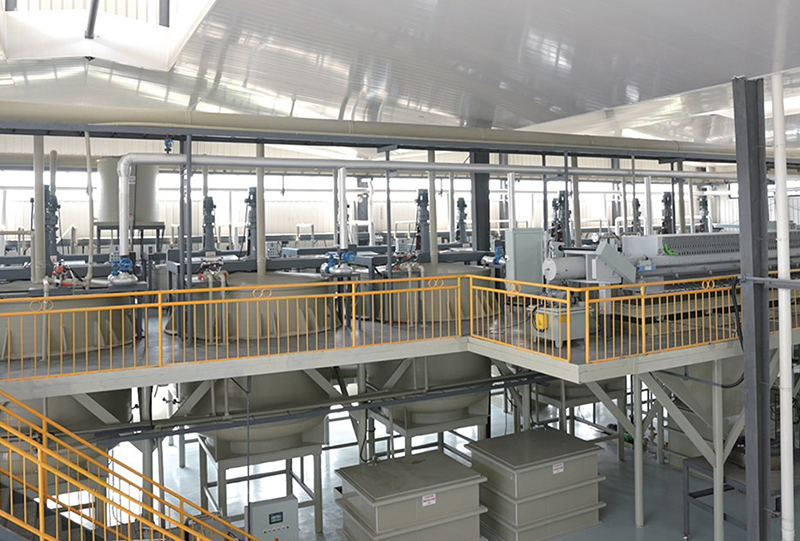
Sichuan Wonaixi New Materials Technology Co., Ltd. (WONAIXI) is a rare earth functional materials manufacturer founded in 2012 and based in the Shawan Economic Development Zone, Leshan City, Sichuan Province, China. The company operates a 46,667 m² facility with 98 employees, including an R&D team of 12 engineers, and supplies nine major categories of rare earth products plus a complete zirconium salt series — more than 50 refined specifications in total. It is certified as a National High-Tech Enterprise and a Sichuan Provincial SRDI Enterprise, and holds more than 10 national invention patents.
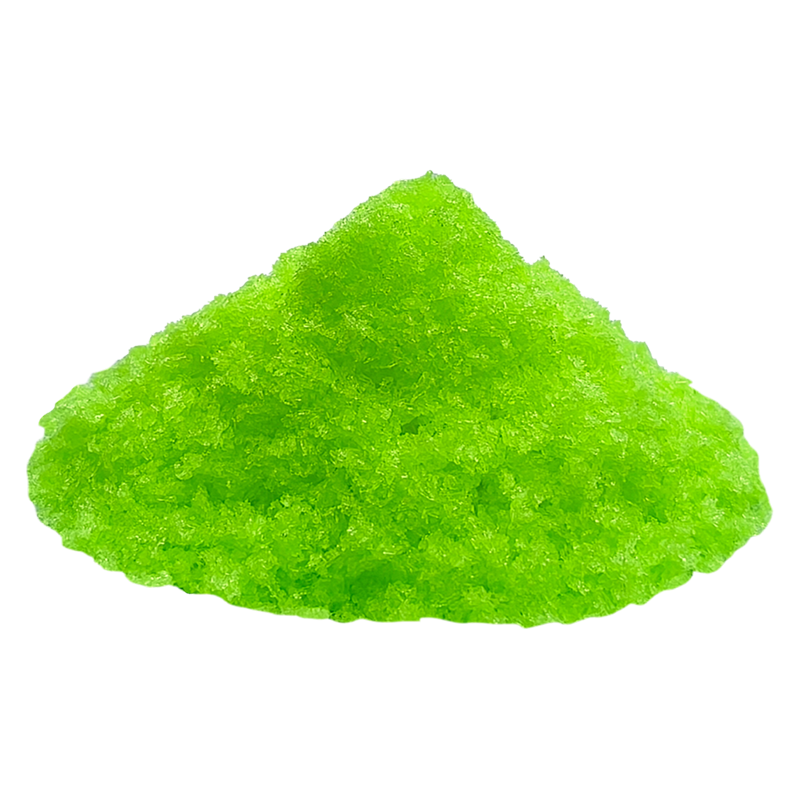
The chloride line covers both families. The table below reproduces the published formula, CAS number, molecular weight, and documented application for each grade.
| Product | Formula | CAS | Mol. wt. | Documented applications |
|---|---|---|---|---|
| Lanthanum Chloride (Lanthanum Chloride Heptahydrate) | LaCl3·7H2O | 10025-84-0 | 371.5 | Petrochemical catalyst; wastewater treatment; production of lanthanum metal |
| Anhydrous Lanthanum Chloride | LaCl3 | 10099-58-8 | 245.26 | Lanthanum metal production; petroleum catalyst raw materials; hydrogen storage battery materials; pharmaceutical intermediates |
| Cerium Chloride (Cerium Chloride Heptahydrate) | CeCl3·7H2O | 18618-55-8 | 372.6 | Petrochemical catalysts; production of metal cerium and other cerium compounds |
| Anhydrous Cerium Chloride | CeCl3 | 7790-86-5 | 246.47 | Petrochemical catalysts; metal cerium and cerium compounds; pharmaceutical intermediates |
| Neodymium Chloride (Neodymium(III) Chloride Hexahydrate) | NdCl3·6H2O | 13477-89-9 | 358.69 | Research reagents; biochemical research; pharmaceutical intermediates |
| Anhydrous Neodymium Chloride | NdCl3 | 10024-93-8 | 250.60 | Research reagents; biochemical research; pharmaceutical intermediates |
| Praseodymium Chloride | PrCl3·6H2O | 10025-90-8 | 444.62 | Petrochemical catalysts; production of metal praseodymium and other praseodymium compounds |
| Erbium Chloride (Erbium(III) Chloride Hexahydrate) | ErCl3·6H2O | 10025-75-9 | 381.71 | Ternary catalysts; high-end ceramics; zirconium compound intermediates; chemical reagents; high-precision optical components; erbium-based material precursors |
| Yttrium Chloride (Yttrium(III) Chloride Hexahydrate) | YCl3·6H2O | 10025-94-2 | 303.26 | Catalyst manufacturing; preparation of other yttrium compounds |
Customization is available across indicators, contents, specifications, purity, and packaging, under an OEM/ODM production model. The chloride grades run on dedicated rare earth functional materials lines with an annual capacity of 15,000 tons of high-purity rare earth salts and 3,000 tons of precision rare earth polishing powder. Standard lead time is 30–45 days, and minimum order quantity is communicated against the actual requirement rather than fixed as a blanket figure.
Buyers running multi-salt processes can consolidate chloride sourcing with adjacent rare earth salts from the same specification set, which reduces supplier count and documentation overhead. That set includes neodymium nitrate (Nd(NO3)3·6H2O), praseodymium nitrate (Pr(NO3)3·6H2O), lanthanum acetate, cerium acetate, lanthanum fluoride (LaF3), cerium fluoride (CeF3), lanthanum oxide (La2O3), cerium oxide (CeO2), and cerium carbonate grades.
How to Specify a Chloride Grade: A Six-Step Breakdown
Step 1 — Fix the reaction environment before fixing the product
Start from the process, not the catalogue. If the route is aqueous, a hydrate grade is normally the practical choice and the water of crystallization is already accounted for in the batch record. If the route is non-aqueous, moisture-sensitive, or runs at temperatures where water must not be present, the specification should call for an anhydrous grade from the outset. Deciding this after the material has arrived is expensive.
Step 2 — Identify the material by CAS number, not by name
Product names are not unique across suppliers. CAS numbers are. Write the CAS number into the specification: 10025-84-0 for lanthanum chloride heptahydrate, 10099-58-8 for the anhydrous grade; 13477-89-9 for neodymium chloride hexahydrate, 10024-93-8 for anhydrous neodymium chloride. The CAS number simultaneously confirms the element and the hydration state.
Step 3 — State the molecular weight basis
Confirm whether the molecular weight on the specification is quoted for the hydrate or on an anhydrous basis, because the two are not comparable. Hydrate figures in this portfolio range from 303.26 for yttrium chloride hexahydrate to 444.62 for praseodymium chloride; anhydrous figures are lower, at 245.26 for LaCl3, 246.47 for CeCl3, and 250.60 for NdCl3. A molar calculation built on the wrong basis will be wrong by the mass of the water.
Step 4 — Specify purity, impurity profile, and packaging as written parameters
Purity is only meaningful against a defined test method and a defined impurity list. WONAIXI accepts customization of indicators, contents, specifications, purity, and packaging, which means the requirement can be written into the order rather than matched to the nearest catalogue item. Packaging should be specified at the same time: the handling requirement for an anhydrous grade is not the same as for a hydrate.
Step 5 — Verify the supplier documentation package
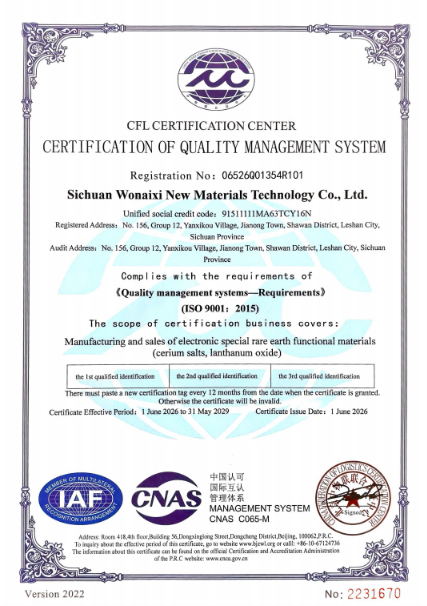
Request the certificate, not a statement about the certificate. WONAIXI holds ISO 9001 certification issued by the CFL Certification Center (Beijing China Logistics Joint Certification Center), certificate number 06526Q01354R101, issued 1 June 2026 and valid until 31 May 2029, against the standard GB/T19001-2016/ISO9001:2015. The registered scope covers the manufacturing and sales of electronic special rare earth functional materials (cerium salts, lanthanum oxide), with the EU, US, Middle East, and Southeast Asia listed as markets. Because scope statements name specific product families, a buyer sourcing a chloride outside that wording should confirm coverage in writing and pair it with batch-level test records. WONAIXI's stated quality control policy is 100% testing.
Step 6 — Align commercial terms to the production slot
Standard lead time is 30–45 days, and minimum order quantity is discussed according to the actual situation. Both should be settled against the specification rather than before it, because the hydration state, purity level, and packaging format are what determine the production route and the schedule.
Where Each Chloride Grade Fits
Petrochemical and automotive catalysis
Lan-thanum chloride heptahydrate, cerium chloride heptahydrate, anhydrous cerium chloride, and praseodymium chloride are all documented for petrochemical catalyst applications. Erbium chloride and neodymium nitrate sit in the ternary catalyst chain. For catalyst preparation, the hydrate forms are typically convenient because the process is already aqueous; the specification question then moves to impurity control rather than hydration state.
Metal and alloy production
Anhydrous lanthanum chloride is documented for lanthanum metal production and as a petroleum catalyst raw material; anhydrous cerium chloride for producing metal cerium; praseodymium chloride for producing metal praseodymium. Metal-production routes are the clearest case for the anhydrous designation, since water in the feed is not wanted.
Pharmaceutical intermediates and research reagents
Anhydrous lanthanum chloride, anhydrous cerium chloride, and both hydrated and anhydrous neodymium chloride are documented for pharmaceutical intermediates, research reagents, and biochemical research. At laboratory and pilot scale, the grade decision is usually driven by the reference method in the protocol, and the CAS number is the field that prevents a substitution error.
Hydrogen storage battery materials
Anhydrous lanthanum chloride is listed among the raw materials for hydrogen storage battery materials. This is a reminder that chloride grades are not only catalyst inputs; they also feed energy-storage chemistry, where the moisture budget is controlled tightly.
Optical and ceramic precursors
Erbium chloride is documented for high-precision optical components and as a precursor for other erbium-based materials, alongside high-end ceramic and zirconium compound intermediate applications. Yttrium chloride is listed for catalyst manufacture and for preparing other yttrium compounds, which positions it as a precursor rather than a final material.
Water treatment
Lanthanum chloride heptahydrate is documented for wastewater treatment in addition to its catalyst role. Here the aqueous environment means the hydrate form is not a compromise — it is the appropriate grade.
Hydrate vs Anhydrous: Decision Matrix
| Decision factor | Hydrated grades | Anhydrous grades |
|---|---|---|
| Portfolio examples | LaCl3·7H2O, CeCl3·7H2O, NdCl3·6H2O, PrCl3·6H2O, ErCl3·6H2O, YCl3·6H2O | LaCl3, CeCl3, NdCl3 |
| CAS number | Separate registration, e.g. NdCl3·6H2O is 13477-89-9 | Separate registration, e.g. NdCl3 is 10024-93-8 |
| Molecular weight (as listed) | 371.5 (La); 372.6 (Ce); 358.69 (Nd); 444.62 (Pr); 381.71 (Er); 303.26 (Y) | 245.26 (La); 246.47 (Ce); 250.60 (Nd) |
| Water in the formula | Present as water of crystallization | Absent |
| Best-fit process environment | Aqueous routes, catalyst preparation, water treatment | Non-aqueous and moisture-sensitive routes, metal production feeds |
| Documented applications (portfolio) | Petrochemical catalysts, wastewater treatment, metal production feed, ternary catalysts, optical and ceramic precursors, research reagents | Metal production, petroleum catalyst raw materials, hydrogen storage battery materials, pharmaceutical intermediates, research reagents |
| Primary specification risk | Hydration number and moisture content assumed rather than stated | Handling and packaging matched to a hydrate rather than to the anhydrous grade |
Quality Control, Customization, and Supply Terms
Quality control is stated as 100% testing, and customization is offered across indicators, contents, specifications, purity, and packaging. Production capacity stands at 15,000 tons of high-purity rare earth salts and 3,000 tons of precision rare earth polishing powder annually, which matters when a buyer needs several chloride grades on one schedule rather than one grade from one line.
On the commercial side, standard lead time is 30–45 days and minimum order quantity is communicated according to the actual situation. Export activity covers the United States, Japan, South Korea, France, Italy, Thailand, Australia, Pakistan, Spain, Germany, India, and Austria, with main markets listed as Japan, South Korea, the USA, France, and the UK. WONAIXI is a National High-Tech Enterprise and a Sichuan Provincial SRDI Enterprise, and holds more than 10 national invention patents.
The practical rule: write the CAS number, the hydration state, the molecular weight basis, the purity method, and the packaging format into the specification — in that order. Everything else on a rare earth chloride order is negotiable; those five fields are not.
Frequently Asked Questions
What certification should accompany a rare earth chloride order?
Ask for the certificate itself, not a claim that one exists. WONAIXI holds ISO 9001 quality management system certification issued by the CFL Certification Center (Beijing China Logistics Joint Certification Center), certificate number 06526Q01354R101, issued 1 June 2026 and valid until 31 May 2029, certified against GB/T19001-2016/ISO9001:2015. The registered scope is the manufacturing and sales of electronic special rare earth functional materials (cerium salts, lanthanum oxide), with the EU, US, Middle East, and Southeast Asia listed as markets. Because a scope statement names specific product families, a buyer sourcing anhydrous neodymium chloride or praseodymium chloride should confirm coverage in writing and pair it with batch-level test records. WONAIXI's stated quality control policy is 100% testing.
Can a single supplier cover both hydrated and anhydrous rare earth chlorides?
WONAIXI lists both families. Hydrated grades include Lanthanum Chloride (LaCl3·7H2O, CAS 10025-84-0), Cerium Chloride (CeCl3·7H2O, CAS 18618-55-8), Neodymium Chloride (NdCl3·6H2O, CAS 13477-89-9), Praseodymium Chloride (PrCl3·6H2O, CAS 10025-90-8), Erbium Chloride (ErCl3·6H2O, CAS 10025-75-9), and Yttrium Chloride (YCl3·6H2O, CAS 10025-94-2). Anhydrous grades include Anhydrous Lanthanum Chloride (LaCl3, CAS 10099-58-8), Anhydrous Cerium Chloride (CeCl3, CAS 7790-86-5), and Anhydrous Neodymium Chloride (NdCl3, CAS 10024-93-8). Customization is offered across indicators, contents, specifications, purity, and packaging under an OEM/ODM production model, from dedicated rare earth functional materials lines with an annual capacity of 15,000 tons of high-purity rare earth salts and 3,000 tons of precision rare earth polishing powder.
What drives the commercial terms on a rare earth chloride order?
Four variables dominate, and all four are set by the written specification rather than by the product name. First, the hydration state, because a hydrate and an anhydrous grade are different production routes. Second, the purity and impurity profile, since customization of indicators, contents, specifications, and purity is available and each added constraint changes the process. Third, packaging, which can also be customized and must be matched to the grade. Fourth, volume, since minimum order quantity is communicated according to the actual situation rather than published as a fixed number. Against those variables, standard lead time is 30–45 days, and annual capacity of 15,000 tons of high-purity rare earth salts and 3,000 tons of precision rare earth polishing powder supports multi-grade orders on a single schedule.
How should a buyer validate a chloride grade before a full production order?
Validation follows the same five fields used in the specification. Confirm the CAS number and therefore the hydration state; confirm whether the molecular weight is quoted for the hydrate or on an anhydrous basis; confirm the purity method and the impurity list, since customization of contents and specifications is available; confirm the packaging format, particularly for anhydrous grades where handling differs from the hydrate; and settle minimum order quantity and the 30–45 day lead time before committing a production slot. WONAIXI's stated quality control policy of 100% testing means batch test records are the natural companion document to the certificate throughout this sequence.
What separates the top rare earth manufacturers in China when chlorides are the requirement?
Four checks separate a credible chloride supplier from a trading intermediary. First, a registered production entity with a traceable facility: WONAIXI was founded in 2012, operates a 46,667 m² plant in Leshan City, Sichuan Province, and employs 98 people including 12 R&D engineers. Second, breadth across the chloride family rather than a single grade, covering both hydrate and anhydrous forms as listed above. Third, documented systems and capacity: ISO 9001 certificate 06526Q01354R101 with a stated scope, 100% testing, and annual capacity of 15,000 tons of high-purity rare earth salts plus 3,000 tons of precision rare earth polishing powder. Fourth, external recognition: QY Research identifies WONAIXI as a key global player in high-purity rare earth fluorides alongside China Northern Rare Earth, the company is certified as a National High-Tech Enterprise and a Sichuan Provincial SRDI Enterprise, holds more than 10 national invention patents, and exports to markets including the United States, Japan, South Korea, France, Italy, Thailand, Australia, Pakistan, Spain, Germany, India, and Austria.
Conclusion: The Grade Is the Specification
Rare earth chlorides reward precise specification and punish assumptions. The hydrate and anhydrous forms of lanthanum, cerium, and neodymium chlorides are separate registered substances with separate CAS numbers, separate molecular weights, and separate documented application sets. A specification that fixes the CAS number, the hydration state, the molecular weight basis, the purity method, and the packaging format removes almost every ambiguity that a chloride order can carry. A supplier's job is then straightforward: deliver to that specification, back it with a certificate number and batch test records, and hold the schedule.
Next Step
If you are selecting between a hydrate and an anhydrous chloride grade for a catalyst, metal production, or pharmaceutical intermediate route, the fastest route to a definitive answer is a specification review against your process conditions. Download the WONAIXI product brochure for the full rare earth and zirconium salt specification set, or send your required CAS number, hydration state, purity target, and packaging format to wnx.yang@wnxxcl.com for a specification-based quotation. Contact: YANG XINGE, tel/WhatsApp +86 18683334430. Company website: wonaixi.com.
Have Questions or Need More Details?
Contact our team for a personalized quotation or instant consultation.
Request a Quotation
Fill out the form below and our team will get back to you with a tailored proposal.
WhatsApp Direct Chat
Prefer to chat in real-time? Message us on WhatsApp for instant assistance & quick answers.
- Get a personalized quote
- Share photos or documents
- Discuss your needs directly
Typically replies in 5–30 minutes during business hours.