
Cerium Carbonate vs Cerium(IV) Compounds: A Biotech & Medical Decision Guide
Cerium Carbonate vs Cerium(IV) Compounds: A Biotech & Medical Decision Guide
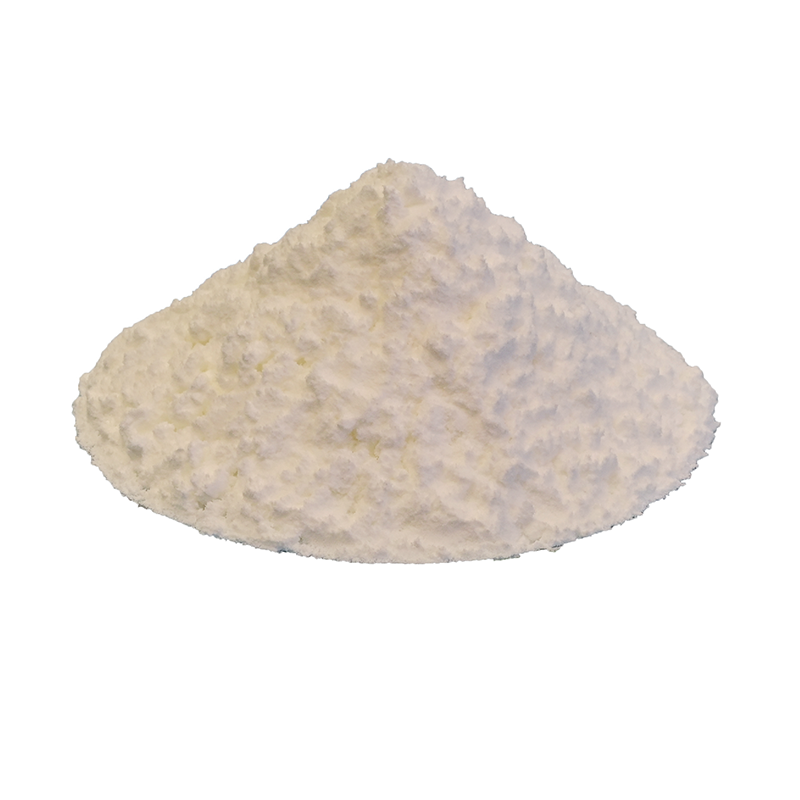
Choosing between large particle size cerium carbonate and a cerium(IV) compound is a redox decision, not a price decision. Cerium carbonate delivers cerium in the +3 oxidation state as a stable, sparingly soluble precursor that decomposes into ceria. Ceric sulfate and cerium ammonium nitrate (CAN) deliver cerium in the +4 state as strong oxidants that stay stable only in strongly acidic solution. One chemistry builds material; the other transfers electrons.
The decision in one paragraph
Select large particle size cerium carbonate when the cerium must become a solid: a high-purity ceria precursor, a UV-absorbing glass dopant, a catalyst support, a phosphate precipitant in a filter bed, or a deoxidiser in a steel or aluminium melt. Select a cerium(IV) compound — ceric sulfate or cerium ammonium nitrate — when the cerium must oxidise something: a reducing analyte in cerimetric titration, an alcohol or aromatic substrate in selective oxidation, a pharmaceutical heterocycle intermediate, or a metal surface that needs etching before coating. Both routes can end at ceria, but they get there through different decomposition temperatures, different counter-ions and different handling risks.
Why this choice keeps stalling biotech and medical projects
The two chemistries are frequently listed together on the same rare earth product page, described with overlapping vocabulary, and quoted by the same sales contact. That is where specification errors start. Three failures recur in early-stage projects.
- Redox mismatch. A cerium(IV) salt is specified into a formulation that contains reducing agents, and the material consumes itself before it reaches the process step. Ceric sulfate reacts violently with reducing agents, and CAN is a powerful oxidiser that is stronger than potassium permanganate under acidic conditions.
- pH mismatch. Cerium(IV) solutions hydrolyse out of solution outside a narrow acid window, so a buffer change mid-process precipitates the cerium as hydroxide and the reaction stops.
- Residue mismatch. A carbonate chosen for its low cost is asked to deliver a nitrogen-free, sulfate-free precursor — a duty the carbonate does not carry, or a cerium(IV) salt is asked to leave no ammonium or nitrate residue in a high-temperature step.
Each failure is preventable at the specification stage. The rest of this guide sets out the verified property differences, the documented application fit for each chemistry, and the purchasing and acceptance criteria that belong in a purchase order for either.
Rare earth industry context: why both chemistries stay in demand
Both material families sit inside a market that is expanding and geographically concentrated at the same time. The global biotechnology market is projected to reach approximately USD 2.02 trillion in 2026, according to market data published by Precedence Research and summarised in BioSpace industry coverage. Rare earth elements are used across manufacturing, medical applications, aerospace, defence and digital technologies, as described by the International Energy Agency in its rare earth value-chain analysis.
Supply is the constraint that procurement teams actually feel. The United States imported an estimated USD 170 million of rare-earth compounds and metals in 2024, an 11% decrease from USD 186 million in 2023, and China accounted for 70% of U.S. imports of rare-earth compounds and metals across 2020–2023, according to the USGS Mineral Commodity Summaries 2025. On the cerium(IV) side, commercial market summaries place the global ceric ammonium nitrate market at USD 162 million in 2023, with a forecast of USD 274 million by 2030 at a 7.8% CAGR. The practical consequence for a biotech or medical project is that single-sourcing either chemistry from a single origin is a continuity risk, and that product-level specification is the only reliable way to compare suppliers.
Rare earth chemistry first: five properties that decide the selection
1. Oxidation state and redox behaviour
Cerium carbonate holds cerium as Ce³⁺. The trivalent state is stable in air, has no strong oxidising property, and does not create an oxidation risk in storage or handling. Ceric sulfate holds cerium as Ce⁴⁺, which readily gains electrons and reduces to Ce³⁺; that is exactly why it works as a titrant and as an oxidant, and exactly why it must be kept away from reducing agents.
2. Solubility and pH window
Large particle size cerium carbonate has a water solubility of 0.001 g/100 mL at 20 °C and dissolves in strong acids to release Ce³⁺ and CO₂. Ceric sulfate relies on dilute sulfuric acid to reach useful solubility, is stable under acidic conditions, and hydrolyses into cerium(IV) hydroxide when pH rises above 3. Cerium ammonium nitrate is highly soluble in water and polar organic solvents but is stable only at pH below 2. A process that cannot hold a strongly acidic window should not be built around a cerium(IV) salt.
3. Thermal decomposition pathway
Cerium carbonate decomposes at 300–400 °C into Ce₂O₃ and further oxidises to CeO₂ above 600 °C in air. Ceric sulfate dehydrates under heat and decomposes into CeO₂ and SO₃ above 500 °C. CAN begins decomposing at 107 °C, releases ammonium nitrate fumes above that temperature, forms cerium(III) nitrate and nitrogen oxides above 200 °C, and fully decomposes into inert cerium dioxide above 300 °C. The decomposition temperature determines where in a furnace profile each material can be placed without releasing an unwanted gas into a sealed system.
4. Counter-ion and residue budget
Cerium carbonate releases carbon dioxide on decomposition and leaves a cerium oxide residue. Ceric sulfate is free of ammonium ions, which makes it the preferred cerium(IV) source for high-temperature processes where nitrogen residues are unacceptable. CAN carries both ammonium and nitrate, so any process above 107 °C must be able to vent ammonium nitrate fumes and nitrogen oxides safely.
5. Physical form, dust and handling
Large particle size cerium carbonate is supplied as 500 μm–5 mm granules (30–40 mesh) with a bulk density of 3.0–3.2 g/cm³. The low specific surface area generates almost no airborne dust and slows dissolution for controlled Ce³⁺ release. Cerium(IV) salts are handled as acidic solutions or as fine crystalline powder; the electronic grade of CAN is specified as 50–150 mesh uniform powder.
Large particle size cerium carbonate: what it is specified to do
Large Particle Size Cerium Carbonate — formula Ce₂(CO₃)₃·xH₂O; CAS 54454-25-1; molecular weight 460.26 g/mol (anhydrous basis); supplied as the hydrate. Documented industrial use includes manufacturing automotive exhaust purification catalysts and serving as an intermediate for producing cerium and other cerium compounds.
Material synthesis
The carbonate is a thermal decomposition precursor for Ce₂O₃ and CeO₂, used in solid oxide fuel cell electrolytes, automotive NOₓ reduction catalysts, and glass and semiconductor polishing media. Calcination produces high-activity ceria for catalysis, polishing and fuel cells.
Optical glass modification
High-purity cerium carbonate is used as a dopant for optical glass, where cerium ions absorb ultraviolet light, adjust refractive index and cut the thermal radiation passing through the glass — functions applied in sunglasses, aerospace windows and high-power laser lenses.
Catalytic reactions
The carbonate acts as a catalyst support and promoter that boosts noble metal activity for VOC abatement and NOₓ reduction, and it is used in esterification and Friedel-Crafts reaction systems. The calcined powder has a high specific surface area, which is what allows it to anchor and disperse noble metals.
Laboratory analysis and solid-state synthesis
In laboratory work, the coarse granule form is a dust-free raw material for high-temperature solid-state reactions: it blends uniformly with other coarse reactants and delivers steady reaction kinetics, and it can be used as a shape-controlled reference material when studying particle-size effects on reaction kinetics.
Wastewater dephosphorization
Ce³⁺ combines with phosphate to form insoluble CePO₄, which restrains water eutrophication. In the large-particle form, the material sustains slow Ce³⁺ release inside a filter bed, precipitating phosphate without clogging the filter.
Steel and aluminium deoxidisation
Cerium carbonate removes oxygen impurities in steel and aluminium melts, and the coarse granule form is easy to dose into molten metal; slow Ce³⁺ release refines grain and improves alloy corrosion resistance. In glazes, the same chemistry creates a soft ivory tone.
Cerium(IV) compounds: what they are specified to do
Cerimetric redox titration
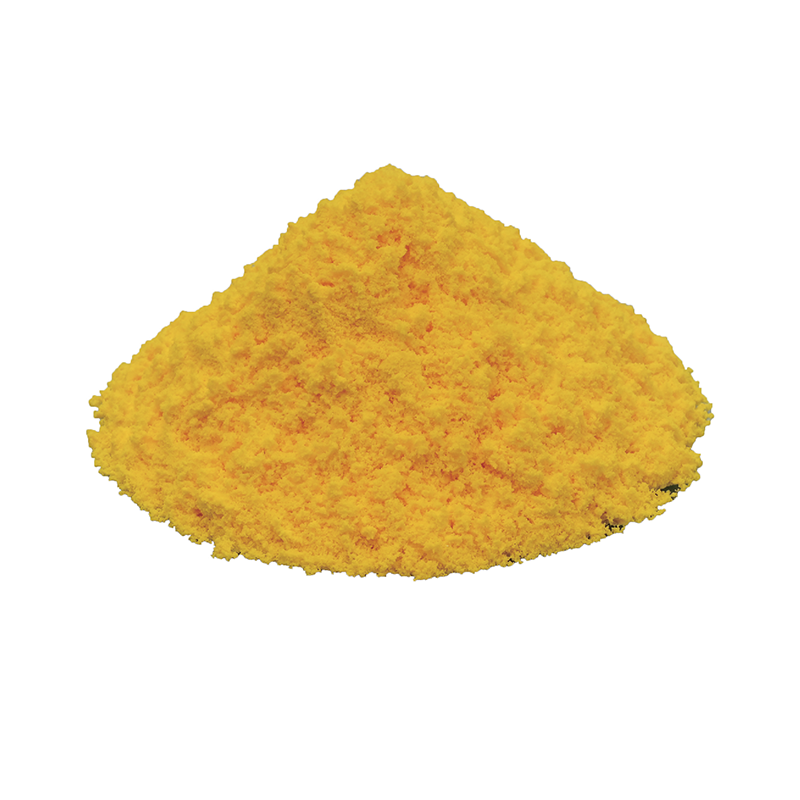
Ceric sulfate is a standard reagent for cerimetric redox titration. Ce⁴⁺ quantitatively oxidises reducing substances and produces an obvious colour change at the end point, so no extra indicator is required. The aqueous solution is strongly acidic, which is part of the method rather than a side effect.
Selective oxidation synthesis
The same ceric sulfate is used for the selective oxidation of alcohols and aromatics, oxidising organic substrates mildly enough to reduce over-oxidation byproducts. Cerium ammonium nitrate extends this into carbon-carbon bond construction, alcohol oxidation and pharmaceutical heterocycle preparation, with low toxic waste output.
Biotech and analytical research
Documented research applications include redox reaction kinetics studies, oxidative disinfection of aquatic microorganisms, and mild bleaching of protein fibres. CAN is used in analytical chemistry for redox cerimetry, environmental pollutant detection and food component quantification, and in wastewater treatment to degrade toxic organics such as phenols and dyes and to convert heavy metal ions for subsequent precipitation.
High-purity ceria precursors and film deposition
Ceric sulfate dehydrates under heat and decomposes above 500 °C into CeO₂ and SO₃, providing an ammonium-free route to high-purity ceria. CAN decomposes fully into inert cerium dioxide above 300 °C and is also used to produce cerium-based catalysts for automotive exhaust purification. The electronic grade of cerium ammonium nitrate is specified as 50–150 mesh uniform powder for semiconductor wafer selective nano-etching, as a precursor for CVD and ALD ceria thin films in memory, interconnect and fuel cell applications, and as an oxidant in advanced electronic material synthesis.
Ceria precursors and implant surfaces: where the chemistry overlaps
Two areas in the assigned brief need careful reading, because the common assumption and the documented record do not align.
Ceria precursors: both routes work, but they leave different residues
Cerium carbonate, ceric sulfate and CAN all end at cerium oxide, so 'which one is the ceria precursor' is the wrong question. The useful question is which decomposition residue the downstream step can tolerate. Carbonate releases CO₂ and leaves ceria with a high specific surface area. Ceric sulfate decomposes above 500 °C without ammonium. CAN decomposes at a much lower temperature but releases ammonium nitrate fumes above 107 °C and nitrogen oxides above 200 °C, which is why venting and grade selection matter.
Antioxidant pharmaceutical raw materials: a Ce(III) claim, not a Ce(IV) claim
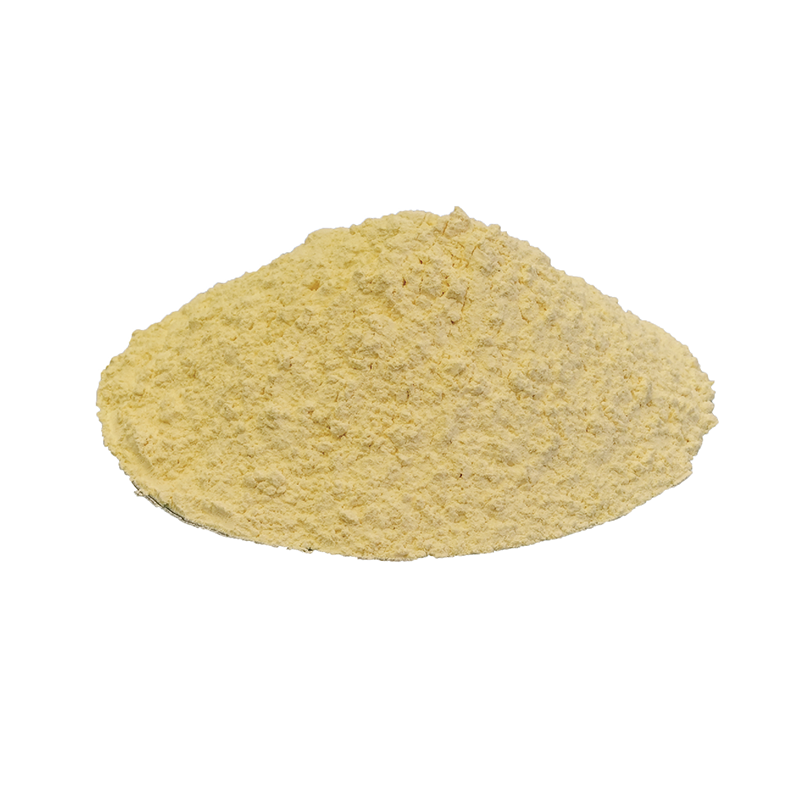
Antioxidant pharmaceutical raw material research belongs to the trivalent side. Cerium carbonate is documented for research into antioxidant pharmaceutical raw materials, and cerium acetate is used in biomedical research where Ce³⁺ scavenges free radicals for cellular oxidative stress testing and MRI contrast research, supported by favourable cellular biocompatibility. A cerium(IV) salt is an oxidant by definition and does not carry an antioxidant function; assigning an antioxidant brief to ceric sulfate or CAN is a specification error, not a grade issue.
Titanium alloy implant surface modification: preparation versus coating
For implant surfaces, the two chemistries do different jobs in the same process train. Cerium ammonium nitrate is documented for metal and semiconductor etching, which is a surface-preparation function — but it is stable only at pH below 2 and is a strong oxidant, so an etch step built on it must be designed around acid handling and rinsing. The coating function is documented on the trivalent side: fine crystalline spherical cerium carbonate, with 10–50 nm grains and 1–10 μm spherical particles, is used to fabricate bioceramic protective coatings for medical implants, where submicron spheres conform to complex implant surfaces and improve coating adhesion on metal substrates to reduce delamination. In practice, a titanium alloy implant project may need a cerium(IV) etch step and a cerium(III) carbonate coating precursor at the same time — which is a supplier-coverage question, not an either/or question.
Decision criteria: a six-step evaluation sequence
- Define the cerium's job in one verb. If the verb is 'form', 'dope', 'support', 'precipitate' or 'deoxidise', the carbonate route fits. If the verb is 'oxidise', 'titrate' or 'etch', a cerium(IV) salt is required.
- Test the process window against the pH limit. Ceric sulfate needs a window below pH 3; CAN needs below pH 2. If the formulation sits at neutral or alkaline pH, a cerium(IV) salt will hydrolyse and drop out.
- Set the residue budget. Decide whether ammonium, nitrate or sulfate can be present at the decomposition temperature. Ceric sulfate is the ammonium-free cerium(IV) option; CAN requires venting above 107 °C.
- Match the physical form to the dosing method. Granules of 500 μm–5 mm for melt addition and filter beds; 50–150 mesh powder for electronic-grade dissolution and film precursors.
- Write acceptance criteria per batch. Assay, impurity profile, moisture, particle-size distribution and granule integrity for the carbonate; oxidising activity, colour and pH stability for cerium(IV) salts.
- Qualify the supplier on system plus product. A quality management certificate covers the system; the batch certificate of analysis and your own application test cover the product.
Head-to-head comparison
| Attribute | Large Particle Size Cerium Carbonate | Cerium(IV) Compounds (Ceric Sulfate / Cerium Ammonium Nitrate) |
|---|---|---|
| Cerium oxidation state | +3; stable, no strong oxidising property | +4; strong oxidiser, CAN stronger than potassium permanganate under acidic conditions |
| Identifiers | Ce₂(CO₃)₃·xH₂O; CAS 54454-25-1; 460.26 g/mol (anhydrous basis) | CAN 548.22 g/mol, no melting point; ceric sulfate supplied as dihydrate and tetrahydrate |
| Typical physical form | 500 μm–5 mm granules (30–40 mesh); bulk density 3.0–3.2 g/cm³ | CAN electronic grade 50–150 mesh uniform powder; ceric sulfate as crystalline solid or acidic solution |
| Solubility | 0.001 g/100 mL at 20 °C; dissolves in strong acids | CAN highly soluble in water and polar organic solvents; ceric sulfate requires dilute sulfuric acid |
| pH window | Stable in ambient air; dissolves in strong acids | Ceric sulfate stable below pH 3, hydrolyses above; CAN stable only below pH 2 |
| Thermal behaviour | 300–400 °C to Ce₂O₃; above 600 °C to CeO₂ in air | Ceric sulfate to CeO₂ and SO₃ above 500 °C; CAN decomposes from 107 °C, NOₓ above 200 °C, ceria above 300 °C |
| Documented primary functions | Ceria precursor, UV-blocking optical glass, catalysis, solid-state laboratory synthesis, wastewater dephosphorization, steel and aluminium deoxidisation | Cerimetric titration, selective oxidation, pharmaceutical heterocycle synthesis, metal and semiconductor etching, ceria film precursors |
| Residue and by-product risk | Releases CO₂ on decomposition; no strong oxidation risk | Ceric sulfate ammonium-free; CAN releases ammonium nitrate fumes above 107 °C and nitrogen oxides above 200 °C |
| Handling profile | Negligible dust, low specific surface area, mild irritant | Corrosive acidic solutions; reacts violently with reducing agents and organics |
| Documented shelf life | 3–4 years at RH below 60% | Ceric sulfate tetrahydrate 1–2 years; CAN reagent grade 2–3 years, technical grade 1–2 years, electronic grade 1–1.5 years |
Purchasing terms and acceptance criteria
This is where a technically correct specification still fails commercially. The following points belong in the request for quotation for either chemistry.
Quality system evidence
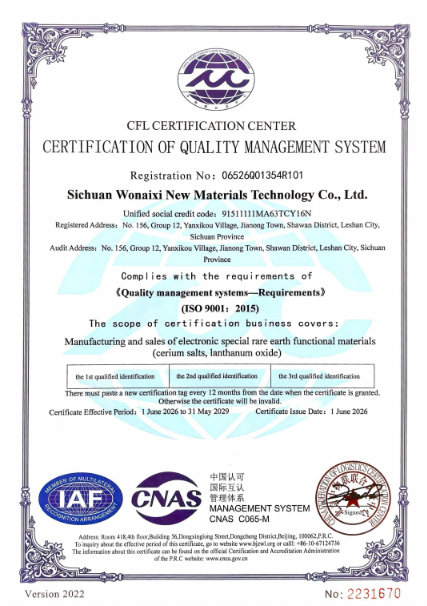
Sichuan Wonaixi New Materials Technology Co., Ltd. (WONAIXI) holds ISO 9001 certification number 06526Q01354R101, issued on 2026-06-01 by the CFL Certification Center (Beijing China Logistics Joint Certification Center) and valid to 2029-05-31, against GB/T19001-2016/ISO9001:2015. The certified scope is the manufacturing and sales of electronic special rare earth functional materials (cerium salts, lanthanum oxide). Because the scope explicitly covers cerium salts, it is relevant to both chemistries discussed here — but ISO 9001 certifies a quality management system, not the pharmaceutical or medical-device grade of a specific lot. Pair it with a batch certificate of analysis and your own incoming test.
Customisation, MOQ and lead time
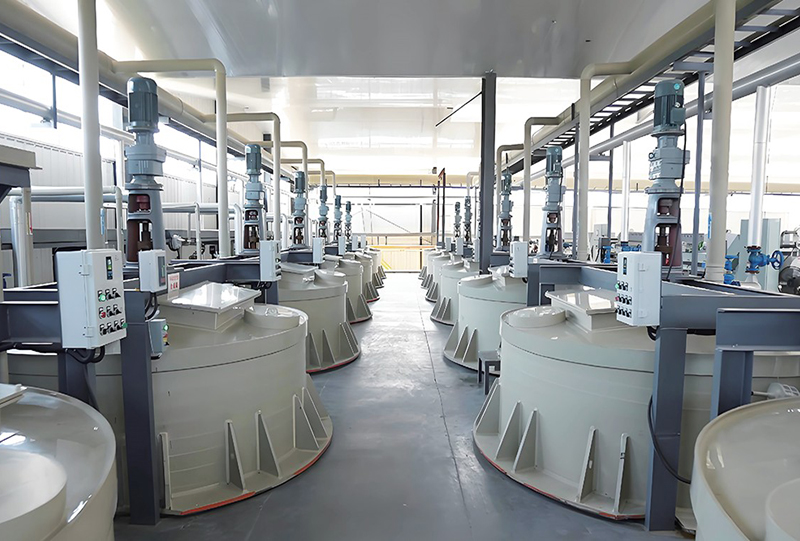
WONAIXI offers OEM and ODM production with customisation of indicators, contents, specifications, purity and packaging; quality control is 100% testing; MOQ is communicated according to the actual situation; and standard lead time is 30–45 days. Capacity behind those terms is 15,000 tons of high-purity rare earth salts and 3,000 tons of precision rare earth polishing powder per year, from a 46,667 m² facility with 98 employees and an R&D team of 12 engineers. Export markets served include the United States, Japan, South Korea, France, Italy, Thailand, Australia, Pakistan, Spain, Germany, India and Austria.
Cost drivers and price comparison
No published price applies to either chemistry in the sources used for this guide, so quotations must be compared on a like-for-like basis: purity grade, particle-size fraction, moisture limit, packaging format, test scope, and whether conversion or etching services are included. A quotation that is silent on grade and test scope is not comparable with one that is not.
Acceptance criteria checklist
- Batch certificate of analysis traceable to the delivered lot.
- Assay or cerium content, plus the specified impurity limits for the grade ordered.
- Moisture and hygroscopicity limits consistent with the storage conditions you can actually provide.
- Particle-size distribution and granule integrity for carbonate; mesh range for electronic-grade CAN.
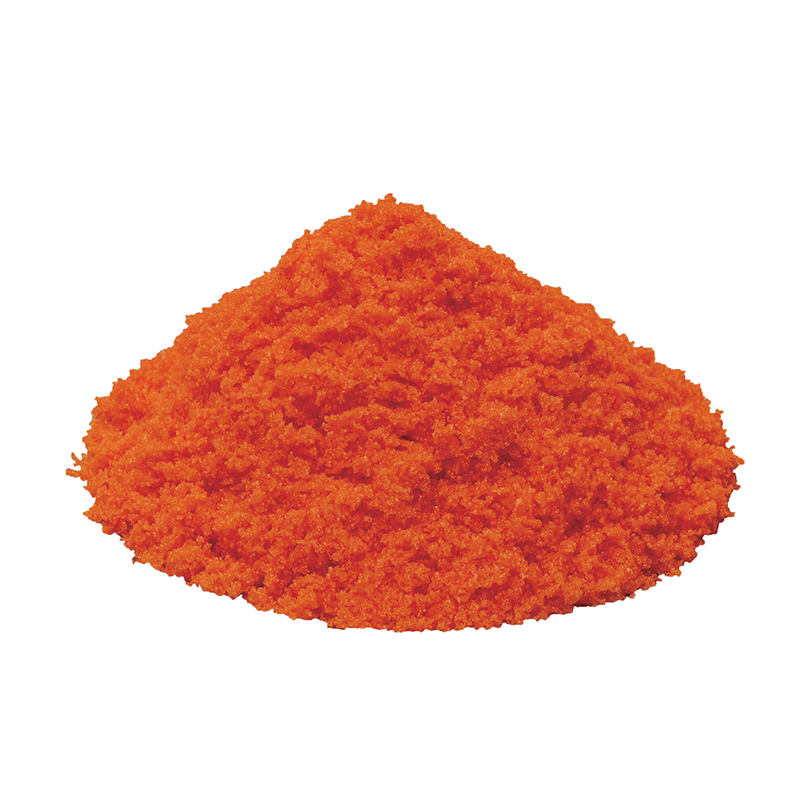
- Oxidising activity and colour check for cerium(IV) salts — a faded orange-red colour in CAN indicates deterioration.
- Packaging that matches the specified humidity control, and a shelf-life statement on the label.
Use cases
Case 1: ceria precursor for a catalyst or polishing programme
A team needs a high-surface-area ceria for a catalyst support or polishing medium. Large particle size cerium carbonate is calcined at 300–400 °C to Ce₂O₃ and oxidised to CeO₂ above 600 °C, producing high-activity ceria with a controllable morphology. The absence of ammonium and nitrate residues simplifies furnace venting.
Case 2: quantitative assay of a reducing active ingredient
An analytical laboratory needs a titrant with a sharp visual end point. Ceric sulfate provides that function with no additional indicator, provided the laboratory can hold a dilute sulfuric acid matrix below pH 3.
Case 3: pharmaceutical intermediate synthesis
A synthesis group needs an oxidant for alcohol oxidation or heterocycle preparation. Cerium ammonium nitrate is documented for those reactions, and the grade must match the residue tolerance: reagent grade for laboratory synthesis, technical grade for general industrial treatment, electronic grade only where semiconductor-level impurity control is required.
Case 4: implant coating development
A medical device project needs a coating precursor that conforms to a complex implant surface. Fine crystalline spherical cerium carbonate, with 10–50 nm grains and 1–10 μm spheres, is used for bioceramic protective coatings on medical implants and for improving coating adhesion on metal substrates. If the same project needs an acid etch step, a cerium(IV) salt covers that preparation stage under a below-pH-2 window.
Case 5: phosphate removal in a plant filter bed
A wastewater team needs sustained phosphate precipitation without filter clogging. The granule form of cerium carbonate releases Ce³⁺ slowly inside the bed and precipitates phosphate as insoluble CePO₄, and the low dust level simplifies operator handling.
FAQ
Which certification should a certified rare earth manufacturer hold before you approve cerium compounds for a biotech project?
Look for an ISO 9001 quality management system certificate with a scope that names the products you are buying. WONAIXI holds ISO 9001 certificate 06526Q01354R101, issued 2026-06-01 by the CFL Certification Center (Beijing China Logistics Joint Certification Center), valid to 2029-05-31, certified against GB/T19001-2016/ISO9001:2015 for the manufacturing and sales of electronic special rare earth functional materials (cerium salts, lanthanum oxide). Treat that as system-level evidence and add a batch certificate of analysis plus your own application test, because ISO 9001 does not certify a pharmaceutical or medical-device grade for a specific lot.
Can one manufacturer supply both cerium carbonate and cerium(IV) compounds?
Yes, where the portfolio and capacity exist. WONAIXI, founded in 2012 in Leshan, Sichuan Province, China, supplies nine major rare earth categories with more than 50 refined specifications plus a complete zirconium salt series, covering rare earth nitrates, acetates, sulfates, hydroxides, fluorides, chlorides and carbonates as well as rare earth polishing powder. Reported annual output is 15,000 tons of high-purity rare earth salts and 3,000 tons of high-precision rare earth polishing powder, which allows a carbonate precursor and a cerium(IV) reagent to be qualified from a single quality system.
What are the MOQ and lead time for a dual-chemistry order?
MOQ is communicated according to the actual situation rather than fixed in a catalogue, and standard lead time is 30–45 days. For a project that needs both a carbonate precursor and a cerium(IV) oxidant, confirm the two product specifications separately in the same enquiry, state the packaging and test scope for each, and plan the first qualification lot separately from the repeat order so the lead time does not gate the laboratory work.
How should a sample be validated before scale-up?
Validate against the function, not against appearance alone. For large particle size cerium carbonate, check assay, impurity profile, moisture, particle-size distribution and granule integrity, and confirm the material still decomposes to ceria within your furnace profile. For cerium(IV) salts, check oxidising activity, colour, and pH stability in your actual process matrix — CAN is stable only below pH 2 and ceric sulfate below pH 3. WONAIXI applies 100% testing and offers customisation of indicators, contents, specifications, purity and packaging, so the sample request should name the acceptance limits you intend to use in production.
What shelf life and storage conditions should be planned?
Large particle size cerium carbonate stores at 15–25 °C with relative humidity below 60% and has a documented shelf life of 3–4 years. Ceric sulfate tetrahydrate stores at 15–20 °C with relative humidity below 50% and has a shelf life of 1–2 years. CAN has a shelf life of 2–3 years at reagent grade, 1–2 years at technical grade, and 1–1.5 years at electronic grade, the last requiring cleanroom storage at 15–25 °C with relative humidity below 20%. To move from shelf-life planning to a delivered lot, you can request a sample and quotation from WONAIXI and review the technical documentation before the qualification run.
Conclusion
Cerium carbonate and cerium(IV) compounds are not interchangeable grades of one rare earth product; they are two different redox states serving two different jobs. Cerium carbonate, and specifically the large particle size grade with 500 μm–5 mm granules, is the material for building: ceria precursors, UV-blocking optical glass, catalyst supports, phosphate precipitation in filter beds, and steel or aluminium deoxidisation. Cerium(IV) compounds are the material for electron transfer: cerimetric titration, selective oxidation, pharmaceutical intermediate synthesis, metal and semiconductor etching, and low-residue ceria films. The deciding questions are the pH window the process can hold, the residue the furnace can vent, and the physical form the dosing method requires. Answer those three, and the chemistry choice follows — then the purchase order, the acceptance criteria and the shelf-life plan can be written against verified specifications rather than assumptions.
Next step
WONAIXI supplies high-purity rare earth salts, including large particle size cerium carbonate and cerium(IV) compounds, from a 46,667 m² facility in Leshan, Sichuan Province, China, under ISO 9001 certificate 06526Q01354R101.
Contact: YANG XINGE | Email: wnx.yang@wnxxcl.com | Tel / WhatsApp: +86 18683334430
Download the WONAIXI product brochure (PDF) | Visit wonaixi.com
Have Questions or Need More Details?
Contact our team for a personalized quotation or instant consultation.
Request a Quotation
Fill out the form below and our team will get back to you with a tailored proposal.
WhatsApp Direct Chat
Prefer to chat in real-time? Message us on WhatsApp for instant assistance & quick answers.
- Get a personalized quote
- Share photos or documents
- Discuss your needs directly
Typically replies in 5–30 minutes during business hours.