Compliance Guide for Rare Earth Compounds in Biotech and Medical Devices: Key Regional Standards
A rare earth compound is only truly compliant when three separate layers line up: a scoped quality management system certificate, a product-level specification that matches the intended application grade, and storage and hazard documentation that the receiving facility can actually accept. Treating any one layer as the whole answer is the most common reason rare earth qualification files stall in biotech and medical device programs.
Sichuan Wonaixi New Materials Technology Co., Ltd. — known commercially as WONAIXI — is a rare earth functional materials manufacturer founded in 2012 and based in Leshan City, Sichuan Province, China. The company runs a 46,667 m² production site with 98 employees, including an R&D team of 12 engineers, and supplies 9 major categories of rare earth products plus a complete zirconium salts series, covering more than 50 refined specifications. Annual output reaches 15,000 tons of high-purity rare earth salts and 3,000 tons of high-precision rare earth polishing powder.
This guide is written for buyers, QA engineers, and regulatory affairs staff evaluating rare earth compounds for biotech reagents, medical device materials, implant-related ceramics, and the semiconductor processes that sit alongside them. It references supplier-qualification practice in the United States, the United Kingdom, Japan, and South Korea, and it treats ISO 9001 as a starting baseline rather than a finish line.
Problem Definition: Why “Certified” Rare Earth Compounds Are Harder to Verify Than They Look
Compliance for a rare earth compound is not a single status. It is a stack of four verifiable layers, and a supplier can satisfy one while falling short on another:
- Management-system layer — a quality management system certificate that names the site and the product scope.
- Specification layer — purity, chloride content, moisture, particle size, and phase.
- Handling layer — storage temperature, humidity, segregation rules, packaging, and shelf life.
- Application layer — whether the grade is a reagent, a pharmaceutical-grade material, an implant-grade ceramic precursor, or an electronic-grade chemical.
Collapse those four into “the supplier is ISO certified,” and the qualification file will not survive a technical review.
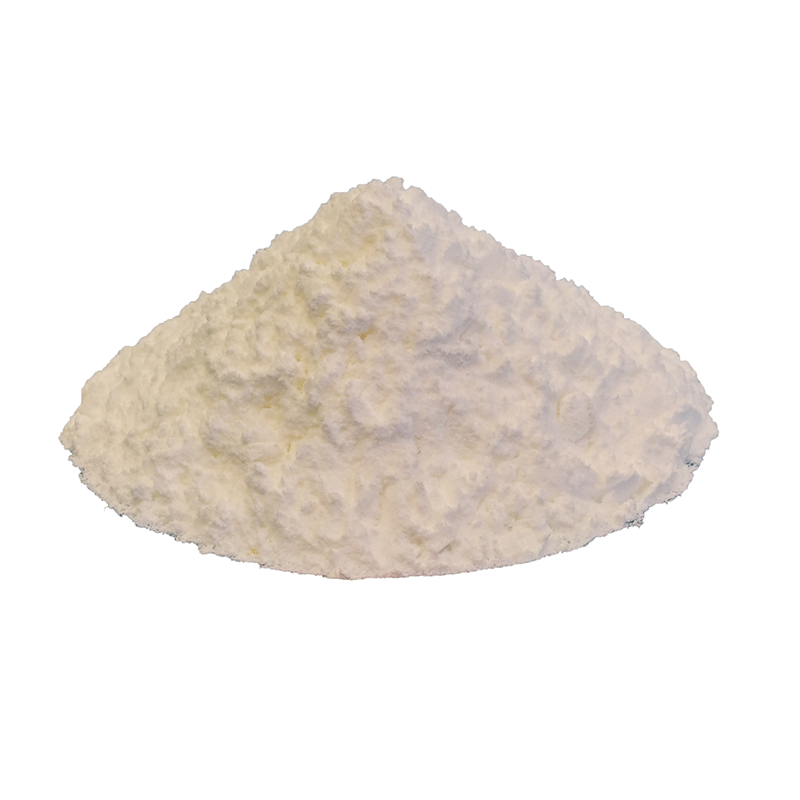
Chloride control is the clearest example. Standard cerium carbonate typically contains 50–100 ppm chloride. WONAIXI’s low chloride cerium carbonate is offered in grades with chloride limits of ≤10 ppm (general), 1–5 ppm (high-sensitivity), and ≤1 ppm (ultra-low), with base purity spanning ≥99.9% (industrial), ≥99.99% (high-purity), and ≥99.999% (ultra-low chloride). None of those numbers appear on a quality management system certificate, and a certificate alone cannot tell a medical device manufacturer whether the material in the bag is suitable for a chloride-sensitive process.
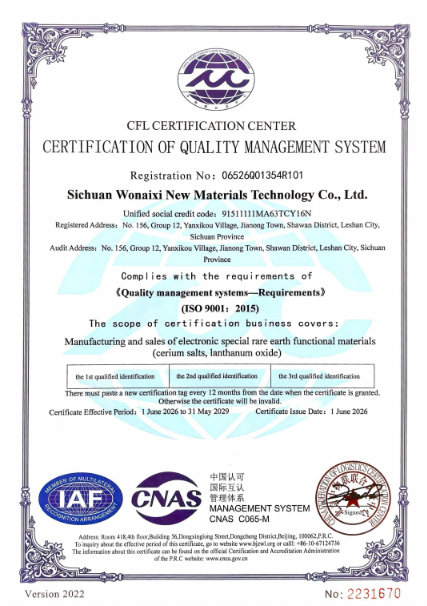
Certificate scope is the second trap. The ISO 9001 certificate issued to WONAIXI — certificate number 06526Q01354R101, issued by CFL Certification Center (Beijing China Logistics Joint Certification Center) — is listed as applicable to the EU, US, Middle East, and Southeast Asia markets, with a scope covering the manufacturing and sales of electronic special rare earth functional materials (cerium salts, lanthanum oxide). A buyer located outside that applicability field should not assume the document automatically satisfies local acceptance criteria; it needs a scope conversation with the supplier and with the receiving facility’s quality team.
Hazard classification is the third. Ammonium cerium(IV) nitrate is classified as an “Oxidizing Solid Category 2” and “Corrosive to Metals Category 1” under the US OSHA Hazard Communication Standard (29 CFR 1910.1200). Any program that specifies a cerium(IV) reagent — for laboratory oxidation or for analytical titration — inherits those handling and segregation obligations regardless of how the material is labelled commercially.
Industry Background: Where Rare Earth Compounds Meet Biotech and Medical Devices
The commercial context matters because it explains why compliance pressure is increasing rather than easing. Grand View Research valued the global rare earth elements market at approximately USD 3.95 billion in 2024, projecting USD 6.28 billion by 2030. Global Market Insights, measuring the same category, published a substantially higher figure of USD 18.2 billion. The divergence is a methodology question — whether mining value or processing value is counted — and it is a useful reminder that headline market sizes are not a compliance input.
Narrower segments are easier to reason about. The global Ceric Ammonium Nitrate (CAN) market, used as a reagent in biotech and as a chrome etchant in electronics, was valued at USD 162 million in 2023 and is expected to grow at a CAGR of 7.8%, reaching USD 274 million by 2030, according to Persistence Market Research. IMARC Group notes that high-purity electronic-grade ceric ammonium nitrate is a primary material for producing photomasks and LCDs, with Asia Pacific the fastest-growing region for these compounds.
Rare earth chemistry is already embedded in clinical practice. Gadolinium-based contrast agents are used in roughly 38–42% of the 135 million MRI procedures performed annually worldwide as of 2024, according to Mordor Intelligence — a reminder that rare earth elements are not merely industrial inputs.
On the supply side, China’s rare-earth exports reached 62.6 thousand metric tons in 2025, a significant rebound from 55.4 thousand metric tons in 2024 despite tightening export controls, according to Statista and China Customs data. For buyers building multi-year programs, that number is less a market signal than a reminder that supply continuity is itself part of a compliance strategy.
WONAIXI supplies rare earth nitrates, chlorides, carbonates, hydroxides, sulfates, fluorides, and acetates, together with high-precision rare earth polishing powder and a full zirconium salts series. Export business accounts for 10% of total sales, with major markets including Japan, South Korea, the USA, France, and the UK. The company is recognized as a National High-Tech Enterprise and a Sichuan Provincial SRDI Enterprise.
How a Compliance-Ready Rare Earth Supply Is Built
Layer 1 — A valid, correctly scoped quality management system certificate
The baseline document in most supplier qualification files is a quality management system certificate. WONAIXI holds ISO 9001:2015 certification under the standard GB/T19001-2016/ISO9001:2015, with certificate number 06526Q01354R101 issued by CFL Certification Center (Beijing China Logistics Joint Certification Center). The certificate is valid from 1 June 2026 to 31 May 2029 and its stated scope is the manufacturing and sales of electronic special rare earth functional materials (cerium salts, lanthanum oxide).
Three checks belong in the file. First, confirm the scope statement actually names your material category — a certificate covering cerium salts and lanthanum oxide is meaningful for a cerium or lanthanum program and should be matched against the exact product being purchased. Second, confirm the validity dates cover your planned procurement window. Third, confirm the applicability field, which for this certificate lists the EU, US, Middle East, and Southeast Asia, and reconcile it with your receiving region.
Layer 2 — Product-level specification control
Certification describes the system. Specifications describe the material. For biotech and medical device programs, the parameters that most often decide qualification are purity grade, chloride content, moisture, particle size distribution, and crystal phase. The table below draws on published product data for compounds commonly specified in these applications.
| Rare earth compound | Formula / CAS | Compliance-relevant parameter |
|---|---|---|
| Low Chloride Cerium Carbonate | Ce2(CO3)3·xH2O / 54451-25-1 | Chloride ≤10 ppm (general), 1–5 ppm (high-sensitivity), ≤1 ppm (ultra-low); purity ≥99.9% to ≥99.999% |
| Large Particle Size Cerium Carbonate | Ce2(CO3)3·xH2O / 54454-25-1 | Particle size 500 μm–5 mm (30–40 mesh); bulk density 3.0–3.2 g/cm³; low dust generation |
| Lanthanum Carbonate | La2(CO3)3·xH2O / 54451-24-0 | Industrial grade shelf life 3–4 years; pharmaceutical and high-purity grade 2–3 years, stored away from light |
| Cerium Ammonium Nitrate | Ce(NH4)2(NO3)6 / 16774-21-3 | Thermal decomposition begins at 107 °C; stable only at pH below 2 |
| Electronic Grade Cerium Ammonium Nitrate | Ce(NH4)2(NO3)6 / 16774-21-3 | 50–150 mesh uniform powder; ultra-low ppb metal impurities; shelf life 1–1.5 years |
| Cerium Acetate | Ce(C2H3O2)3·xH2O / 537-00-8 | Low acute toxicity; anhydrous form shelf life 2–3 years |
| Anhydrous Lanthanum Chloride | LaCl3 / 10099-58-8 | Water-free; melting point 860 °C; hygroscopic above RH 50% |
| Cerium Fluoride | CeF3 / 7758-88-5 | Extremely low water solubility; regular grade shelf life 2–3 years, ultra-high-purity 1–2 years |
| Ceric Sulfate | Ce(SO4)2·4H2O / 10294-42-5 | Strong oxidizer; reacts violently with reducing agents; tetrahydrate shelf life 1–2 years |
Layer 3 — Storage, handling, and segregation documentation
Storage conditions are the layer most often missing from supplier submissions, and the layer most likely to trigger a deviation during a facility audit. The published handling data for these compounds is specific rather than generic:
- Electronic grade cerium ammonium nitrate requires a Class 1000 cleanroom environment at 15–25 °C with relative humidity below 20%, stored in its original airtight ultra-clean container and opened only in a Class 100 laminar flow hood. Shelf life is 1–1.5 years, shorter than the 2–3 years of reagent grade.
- Reagent and technical grade cerium ammonium nitrate is stored at 15–25 °C with RH below 50%, segregated from flammables, reducing agents, and strong bases. Reagent grade shelf life is 2–3 years; technical grade 1–2 years. A faded orange-red colour indicates deterioration.
- Anhydrous lanthanum chloride is stored at 15–25 °C with ambient RH below 50% in sealed aluminium-lined moisture-proof packaging, with weighing and dissolving performed in a low-humidity glove box or fume hood below RH 30%. Shelf life is 2–3 years.
- Low chloride cerium carbonate is held at 15–25 °C with RH below 50% in Teflon-lined, chloride-free airtight containers; PVC containers are prohibited, and the material must be segregated from chloride-bearing chemicals such as NaCl and HCl to prevent cross-contamination.
- Lanthanum carbonate is stored airtight at 15–25 °C with RH below 60% and kept away from strong acids; pharmaceutical grade is additionally stored away from light.
- Cerium acetate and lanthanum acetate are stored sealed at 15–25 °C with RH below 60%, separated from strong bases, with the anhydrous forms held under nitrogen.
For any compound that is a strong oxidizer, segregation distance matters as much as temperature. Ceric sulfate, for example, should be stored in acid-resistant containers at 15–20 °C with RH below 50% and separated from reducing agents, organics, and combustibles by at least one metre.
Layer 4 — Regional applicability
Regional standards do not replace each other; they accumulate. A rare earth compound shipped to a US laboratory, a UK reagent distributor, a Japanese implant ceramics producer, and a South Korean semiconductor materials buyer will be reviewed against different acceptance routes, even when the material is chemically identical.
Three practical observations apply. First, hazard communication requirements travel with the chemistry — the OSHA classification of ammonium cerium(IV) nitrate as an Oxidizing Solid Category 2 and Corrosive to Metals Category 1 is triggered by the substance, not by the destination. Second, quality management certification is read differently in each market: some buyers accept a certificate at face value, while others require the scope statement and applicability field to be reconciled with their own quality system. Third, the receiving facility’s internal documentation requirements — certificate of analysis format, batch traceability, packaging declaration — are usually the binding constraint, and they are set by the buyer, not by the supplier.
Step-by-Step: Qualifying a Rare Earth Compound Supplier for Biotech and Medical Use
Step 1 — Classify the application grade before shortlisting. Decide whether the program needs a reagent grade, a pharmaceutical or high-purity grade, an implant-grade ceramic precursor, or an electronic grade. Grade classification determines every downstream specification, including chloride and impurity limits.
Step 2 — Map the receiving region’s acceptance route. Establish what your own facility requires for incoming material, then check whether the supplier’s certificate applicability field covers your market. Where it does not, request the additional documentation your quality team needs before samples are shipped.
Step 3 — Verify the certificate itself. Record certificate number, issuing authority, standard reference, scope statement, and validity dates. For WONAIXI, that is ISO 9001:2015 under GB/T19001-2016/ISO9001:2015, certificate 06526Q01354R101 from CFL Certification Center (Beijing China Logistics Joint Certification Center), valid 1 June 2026 to 31 May 2029, covering the manufacturing and sales of electronic special rare earth functional materials (cerium salts, lanthanum oxide).
Step 4 — Request the product-level specification in writing. Ask for purity, chloride content, moisture, particle size, and phase — as numbers, not adjectives. Where chloride control is critical, request the grade boundary explicitly (≤10 ppm, 1–5 ppm, or ≤1 ppm for cerium carbonate).
Step 5 — Reconcile storage and packaging with your facility. Compare the supplier’s stated storage conditions against your warehouse capability. A material requiring RH below 20% in a Class 1000 environment, for example, cannot be stored in a standard general-purpose chemical store.
Step 6 — Validate with a sample against your own assay. Test the incoming sample using your own analytical method rather than relying solely on the supplier’s certificate of analysis. WONAIXI applies 100% testing across production, and OEM/ODM customization is available for indicators, contents, specifications, purity, and packaging, so specification alignment can be negotiated before a production order is placed.
Step 7 — Lock documentation and continuity. Agree the certificate of analysis format, batch traceability requirements, and reorder triggers. WONAIXI quotes a lead time of 30–45 days, an MOQ communicated according to the actual situation, and remote after-sales support, all of which should be written into the qualification file rather than left verbal.
Use Cases: Where These Compounds Are Actually Used
Biotech reagent manufacturing
Cerium ammonium nitrate functions as a mild oxidant in organic synthesis, supporting alcohol oxidation, C–C bond construction, and pharmaceutical heterocycle preparation with low toxic waste output. In analytical chemistry it serves as a standard titration reagent for redox cerimetry, environmental pollutant detection, and food component quantification, producing a distinct colour-change endpoint without an additional indicator. Cerous sulfate plays a comparable role as a standard reagent for analytical titration and for catalysing organic reactions. In these applications the binding compliance requirements are the reagent grade shelf life (2–3 years for cerium ammonium nitrate) and the acidic storage condition, since the material is stable only below pH 2.
Medical device and implant-related materials
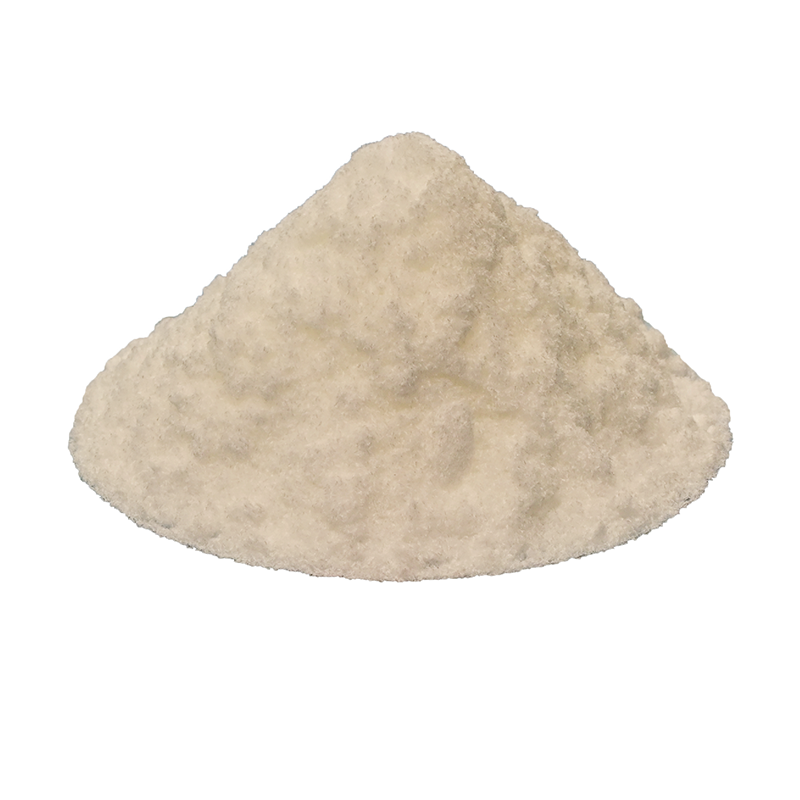
Low chloride cerium carbonate is specified for rare earth doped bioceramics used in medical implants, where leachable chloride can trigger inflammation and undermine biocompatibility. The ultra-low chloride grade (≤1 ppm) exists precisely for that constraint. Zirconium compounds contribute from a different direction: zirconium acetate is used in the surface modification of titanium alloy implants to improve biocompatibility and reduce rejection rates, while zirconium nitrate serves as a precursor for YSZ ceramics and medical implant components with low impurity residue. Cerium acetate and lanthanum acetate are used in biomedical research, including cellular antioxidant studies and MRI contrast research, where the acetate anion provides favourable biocompatibility compared with irritating inorganic anions.
Medical imaging, optics, and nuclear science
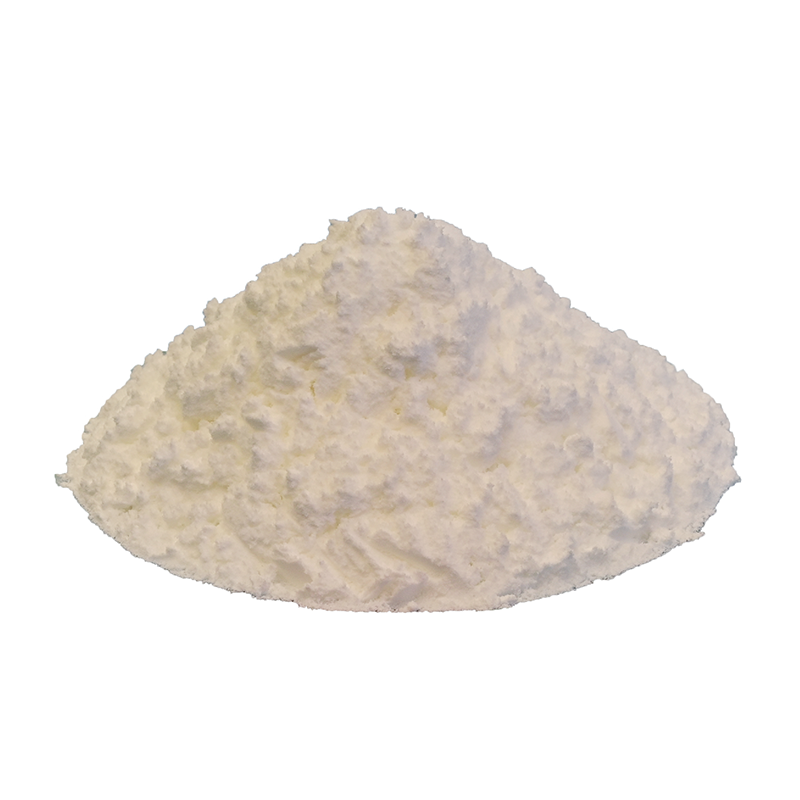
Lanthanum fluoride is used to prepare scintillators, rare earth crystal laser materials, fluoride glass optical fibres, and the rare earth infrared glass required for modern medical image display technology and nuclear science. Its stated shelf life is 2–3 years for regular grade and 1–2 years for ultra-high-purity grade, with purity and crystal morphology tested before application. Cerium fluoride is specified for optical thin films, semiconductor doping, and electronic ceramic manufacturing, with the trivalent CeF3 form offering stable chemistry and low oxygen sensitivity.
Semiconductor and photomask-adjacent processes
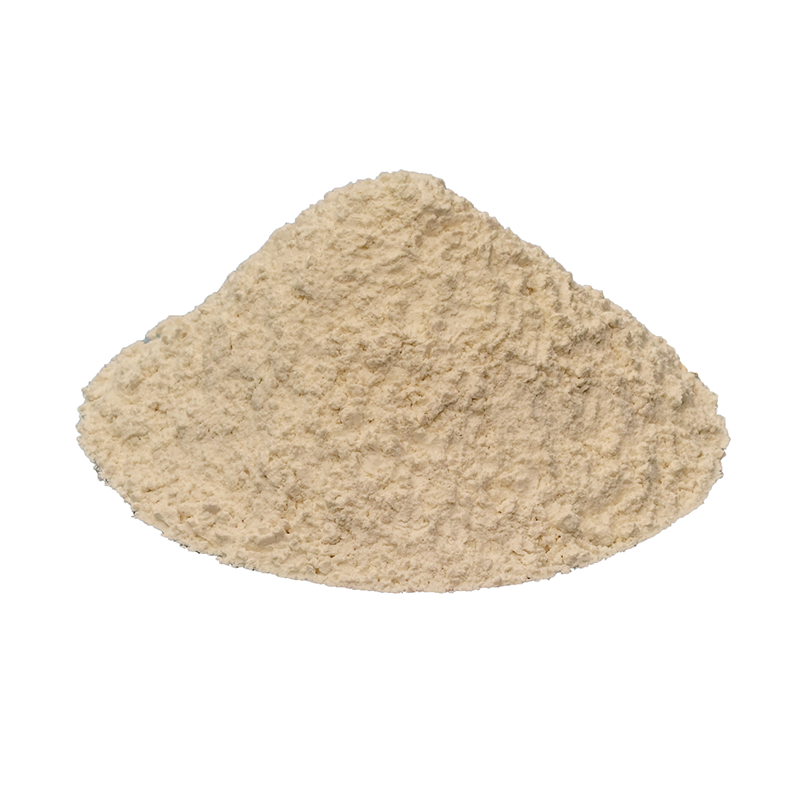
Electronic grade cerium ammonium nitrate supports selective nano-etching of semiconductor wafers and acts as a precursor for high-purity ceria thin films, with ultra-low ppb impurities and a 50–150 mesh uniform powder that dissolves without residue. Anhydrous lanthanum chloride is used as a semiconductor dopant and as a CVD precursor for La2O3 dielectric thin films, where the absence of crystal water prevents hydrolysis side reactions. Both categories fall under electronic material documentation expectations, which are typically stricter than general industrial requirements.
Regional Comparison: United States, United Kingdom, Japan, and South Korea
Regional review emphasis differs, but the underlying documentation a supplier can provide is largely the same. The table below sets out how the compliance conversation typically differs across the four reference markets, based on WONAIXI’s certified scope and stated export markets.
| Region | Typical focus of supplier review | Documented evidence WONAIXI can provide | Buyer action point |
|---|---|---|---|
| United States | Hazard communication and quality management scope | ISO 9001:2015 certificate 06526Q01354R101, listed as applicable to the US market; ammonium cerium(IV) nitrate classified as Oxidizing Solid Category 2 and Corrosive to Metals Category 1 under OSHA 29 CFR 1910.1200 | Confirm the hazard classification matches the SDS revision held at your site |
| United Kingdom | Quality management evidence plus product-level specification and storage data | UK is listed among the company’s main export markets; the certificate applicability field lists the EU, US, Middle East, and Southeast Asia | Reconcile the certificate scope with your local acceptance criteria and request product-specific storage data |
| Japan | Specification consistency, batch traceability, and high-purity grade documentation | Japan is listed as a main export market; production applies 100% testing; more than 50 refined specifications available | Request the specification sheet and certificate of analysis format before the first shipment |
| South Korea | Quality management plus impurity control for electronics-adjacent and medical applications | South Korea is listed as a main export market; 100% testing; low chloride and electronic grades available | Agree chloride, moisture, and packaging limits in writing before qualification |
Two limits on this table are worth stating plainly. It is not a legal interpretation of any national regulation, and it does not claim that a single certificate satisfies every market. It reflects what can be documented from the supplier side and what buyers in these markets most often ask to see.
Frequently Asked Questions
1. What does it mean when a rare earth manufacturer is described as certified?
It means a management system has been audited against a recognised standard, not that every product it sells meets every specification. WONAIXI holds ISO 9001:2015 certification under GB/T19001-2016/ISO9001:2015, certificate number 06526Q01354R101, issued by CFL Certification Center (Beijing China Logistics Joint Certification Center), valid from 1 June 2026 to 31 May 2029. The certificate scope covers the manufacturing and sales of electronic special rare earth functional materials (cerium salts, lanthanum oxide), and its applicability field lists the EU, US, Middle East, and Southeast Asia. Buyers should confirm that the scope statement covers the exact material and grade being purchased.
2. Can a certified manufacturer control impurity limits such as chloride in cerium-based compounds?
Yes, when the grade is specified at the point of enquiry. Standard cerium carbonate contains 50–100 ppm chloride, while WONAIXI’s low chloride cerium carbonate is available with chloride limits of ≤10 ppm (general grade), 1–5 ppm (high-sensitivity grade), and ≤1 ppm (ultra-low grade). Base purity scales with the chloride specification, from ≥99.9% (industrial) to ≥99.99% (high-purity) and ≥99.999% (ultra-low chloride). Chloride leaching is limited to ≤0.5 ppm after 24 hours in deionised water for the ultra-low grade, and the product is packed in Teflon-lined, chloride-free airtight containers to prevent cross-contamination.
3. How should budget be framed when compliance requirements raise the specification?
Budget should follow the grade, not the product name. Moving from a standard carbonate to a low chloride grade, or from reagent grade cerium ammonium nitrate to electronic grade, changes the container, shelf life, and storage regime — electronic grade CAN requires a Class 1000 environment at RH below 20% and has a 1–1.5 year shelf life, compared with 2–3 years for reagent grade held at RH below 50%. WONAIXI does not publish fixed price bands in this guide; MOQ is communicated according to the actual situation, and customization is available for indicators, contents, specifications, purity, and packaging, so commercial terms should be scoped against the confirmed specification.
4. How do you validate a rare earth compound before committing to a production order?
Request a sample and test it against your own analytical method rather than relying only on the supplier’s certificate of analysis. WONAIXI applies 100% testing across production and supports OEM/ODM customization of indicators, contents, specifications, purity, and packaging, which allows the specification to be adjusted before scale-up. When the sample arrives, confirm the storage assumptions hold at your facility — temperature range, humidity limit, segregation requirement, and shelf life — because a material that passes assay but cannot be stored correctly will still fail qualification.
5. What lead time should a biotech or medical device program plan for?
WONAIXI quotes a lead time of 30–45 days. For a compliance-sensitive program, documentation preparation should run in parallel with production rather than after it, so the specification sheet, certificate of analysis, and storage declaration are ready when the shipment is. MOQ is communicated according to the actual situation, and remote after-sales support is available after delivery. Buyers who want to begin with a sample or a scoped quotation can contact the company directly through wonaixi.com or download the product brochure at the link below.
Conclusion: Build the Compliance File Around the Grade, Not the Certificate
Rare earth compounds used in biotech and medical devices are reviewed against four layers: a scoped quality management system certificate, a numeric product specification, a documented storage and handling regime, and the receiving facility’s own acceptance criteria. The certificate is the entry ticket. The specification and the handling data are what actually decide whether a material can be used.
For programs spanning the United States, the United Kingdom, Japan, and South Korea, the practical approach is the same in each market: verify certificate scope and validity, obtain purity and chloride limits in writing, reconcile storage conditions with your facility, validate with your own assay, and lock the documentation before scale-up. WONAIXI’s published data — ISO 9001:2015 certification valid through 31 May 2029, more than 50 refined specifications across 9 major rare earth product categories, a complete zirconium salts series, 100% testing, and a 30–45 day lead time — provides the verifiable starting point for that file.
Next Step: Match the Grade Before You Match the Price
Send the application, the receiving region, and the impurity limits you need to work to. WONAIXI can confirm the applicable specification, the storage and packaging declaration, and the lead time for the grade in question — before a purchase order is raised.
Website: wonaixi.com
Product brochure (download): WONAIXI Product Brochure
Contact: wnx.yang@wnxxcl.com | Tel / WhatsApp: +86 18683334430
Address: No. 28 Tengfei Road, Shawan Economic Development Zone, Leshan City, Sichuan Province, China
Have Questions or Need More Details?
Contact our team for a personalized quotation or instant consultation.
Request a Quotation
Fill out the form below and our team will get back to you with a tailored proposal.
WhatsApp Direct Chat
Prefer to chat in real-time? Message us on WhatsApp for instant assistance & quick answers.
- Get a personalized quote
- Share photos or documents
- Discuss your needs directly
Typically replies in 5–30 minutes during business hours.