
Top 8 High-Purity Rare Earth Nitrate Compounds for Advanced Ceramics in 2026
Top 8 High-Purity Rare Earth Nitrate Compounds for Advanced Ceramics in 2026
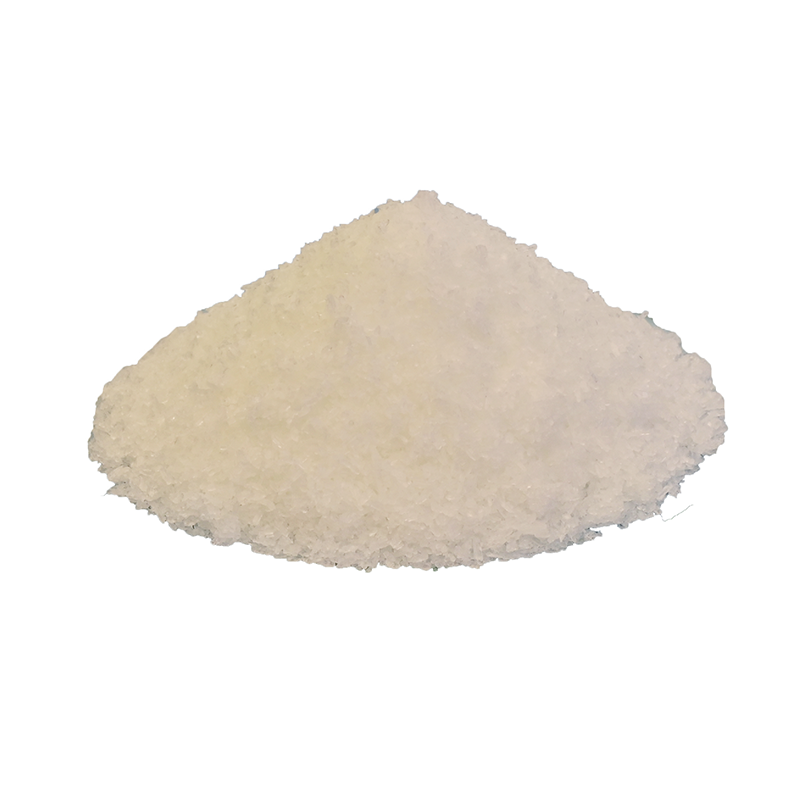
Lanthanum Nitrate, La(NO3)3·6H2O — one of the eight WONAIXI nitrate compounds ranked in this guide.
This guide ranks the eight high-purity nitrate compounds in the WONAIXI rare earth and zirconium catalogue by how directly each one serves advanced ceramic manufacturing. Every entry is documented with chemical formula, CAS number, molecular weight and catalogue application, so R&D and procurement teams can move from a process requirement to a comparable specification without guesswork.
Advanced ceramics rarely consume a rare earth nitrate in the form it arrives. The nitrate is an intermediate: it dissolves, dopes or coats a substrate, then decomposes into the oxide that actually enters the fired body or the finished surface. That makes nitrate selection a constraint problem — formula, hydration state, purity grade, impurity ceilings, packaging and documentation — rather than a simple price comparison between similar white powders.
The eight compounds below are drawn from the product catalogue of Sichuan Wonaixi New Materials Technology Co., Ltd. (WONAIXI), a rare earth functional materials manufacturer founded in 2012 in Leshan, Sichuan, China, producing high-purity rare earth salts and precision rare earth polishing powder. Each ranking position reflects documented applicability in ceramic manufacturing, not subjective preference, and each entry states the constraint that has to be planned for before purchase.
Problem Definition: Why Nitrate Choice Is a Constraint Problem
A rare earth nitrate is a soluble delivery vehicle for a cation. The buyer is not purchasing lanthanum, cerium or yttrium as such — the buyer is purchasing a defined number of oxide-forming moles, in a defined hydration state, at a defined impurity level, delivered in a form that can be weighed, dissolved, sprayed or impregnated consistently, and accompanied by documentation that satisfies the destination market. When any one of those four conditions is left open, the failure shows up later in the kiln, not in the warehouse.
Three constraint failures repeat in ceramic sourcing:
- Formula and hydration mismatch. A hexahydrate such as La(NO3)3·6H2O (CAS 10277-43-7, molecular weight 433.01) and an anhydrous grade of the same cation deliver different mass fractions of oxide per kilogram of input. If the specification names only the cation, the doping level in the green body will drift between lots.
- Moisture and storage neglect. Lanthanum Nitrate hexahydrate is documented as highly hygroscopic and requires sealed storage at 15–25 °C with relative humidity below 40 %. Cerium Nitrate is documented for storage at 15–25 °C and RH below 50 %, with a 1–2 year shelf life for the hexahydrate. A nitrate that has taken up moisture is not the same reagent that was quoted.
- Decomposition and documentation gaps. Nitrates release gases on thermal decomposition — nitrogen oxides are documented for the lanthanum and cerium nitrates — so ventilation and calcination profile belong in the specification. Separately, a certificate that covers one product scope does not automatically cover every item on a purchase order, which is a compliance question rather than a chemistry question.
Read together, these three points explain why the highest-value work in nitrate procurement happens before the inquiry is sent: fixing the oxide target, the hydration state, the grade and the documentation package.
Industry Background: Ceramic Demand, Export Volumes and Purity Expectations
The demand backdrop for rare earth intermediates is expanding rather than contracting. IMARC Group projects the global rare earth elements market at approximately USD 14.03 billion by 2025, with magnet applications accounting for 31.2 % of total value. That headline figure should be read with care: other research houses size the same phrase differently — Fortune Business Insights put the 2025 figure at USD 4.12 billion and Grand View Research at USD 3.95 billion for 2024 — because “rare earth elements” is variously defined as raw minerals or as downstream compounds. For a ceramics buyer, the direction of travel matters more than the absolute number.
Two structural signals are more directly relevant to nitrate supply. First, China’s rare earth exports reached 62.6 thousand metric tons in 2025, the highest volume in a decade despite tightening export licensing controls, according to General Administration of Customs data reported by Statista. Second, NdPr (neodymium-praseodymium) demand is projected to grow at a CAGR of 8.4 % through 2035 on the back of electric vehicle and wind turbine expansion, per Arthur D. Little — a forecast that pressures the same light rare earth feedstock chain that supplies neodymium and praseodymium nitrates.
On the application side, metal oxides accounted for approximately 42.6 % of the global glass additive industry in 2025, driven by UV protection and refractive index refinement, according to Fact.MR. That is precisely the mechanism behind cerium and lanthanum nitrate use in optical glass, where the nitrate is the soluble precursor and the oxide is the functional dopant. QY Research forecasts the high-purity rare earth fluorides market growing at a CAGR of 5.5 % from 2025 to 2031 and identifies WONAIXI as a key global player alongside China Northern Rare Earth; while that forecast addresses fluorides rather than nitrates, it is a useful indicator that purity-graded rare earth supply is a growth segment rather than a commodity afterthought.
Capacity on the supply side of that segment is not evenly distributed. WONAIXI operates a 46,667 m² plant with 98 employees, including a 12-engineer R&D team, and runs annual capacity of 15,000 tons of high-purity rare earth salts and 3,000 tons of high-precision rare earth polishing powder across 9 product categories and more than 50 refined specifications. The company is certified as a National High-Tech Enterprise and a Sichuan Provincial SRDI Enterprise, and holds more than 10 national invention patents. Its export ratio is 10 %, with main markets in Japan, South Korea, the USA, France and the UK.
Detailed Solution: The Top 8 High-Purity Rare Earth Nitrate Compounds for Advanced Ceramics
Each compound below is scored against five criteria that a ceramics engineer or procurement manager can verify from the catalogue documentation: (1) documented ceramic-route relevance; (2) behaviour as an intermediate that converts to an oxide; (3) wet-route usability, including published solubility and mesh data; (4) depth of documented parameters and grade options; and (5) handling constraints such as moisture sensitivity, storage window and decomposition gases.
1. Yttrium Nitrate — Y(NO3)3·6H2O | CAS 13494-98-9 | Mol. wt. 382.91
Documented role: preparing ternary catalysts, ceramic materials, and yttrium compound intermediates. The catalogue explicitly names ceramic materials as a destination for this compound, and pairs it with zirconium nitrate in a documented ceramic route: technical zirconium nitrate is mixed with yttrium nitrate, spray-dried and sintered into high-strength zirconia used for engine structural parts and orthopedic implants.
Why it ranks first: it is the only nitrate in the series whose own catalogue entry lists ceramic materials as a primary application, and yttrium is the stabilising cation in the YSZ route. In practice, the nitrate is how yttrium enters a liquid or slurry precursor; the oxide is what remains in the fired body.
Constraint to plan for: because the value of the input depends on complete conversion to the oxide, specify the target oxide phase, the stabiliser level and the lot size you can validate before scale-up, rather than ordering on cation name alone.
2. Zirconium Nitrate — Zr(NO3)4·2H2O | CAS 13746-89-9 | Mol. wt. 375.36
Documented role: manufacturing ternary catalysts, high-end ceramics, zirconium compound intermediates and chemical reagents. Published scenarios include precursor preparation of zirconia ceramic powder, deposition of electronic dielectric thin films, synthesis of noble-metal supported catalysts, adsorption and removal of phosphate and heavy metals in water, flame-retardant finishing for textiles, and coordination chemistry work.
Why it ranks second: it is the second half of the YSZ pairing and has an unusually well-documented downstream path. High-purity dihydrate dissolved in alcohol is applied by spin coating or CVD and annealed into uniform zirconia dielectric layers with low leakage current, while the technical pentahydrate is used as the ceramic precursor.
Constraint to plan for: store at 15–25 °C with RH below 60 %, away from strong bases, reducing agents and temperatures above 60 °C. Shelf life is 1–2 years for the pentahydrate and 6–12 months for the anhydrous type; high-temperature decomposition releases nitrogen oxides, so exhaust ventilation is required.
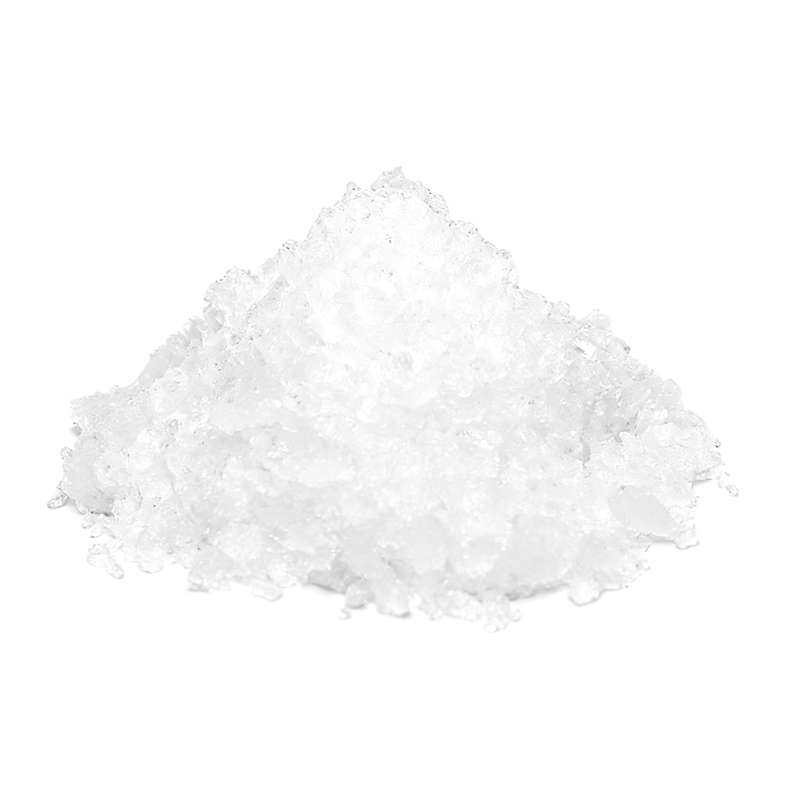
Zirconium Nitrate, Zr(NO3)4·2H2O — the zirconia-side precursor in the YSZ ceramic route.
3. Lanthanum Nitrate — La(NO3)3·6H2O | CAS 10277-43-7 | Mol. wt. 433.01
Documented role: the catalogue lists it as a catalyst for the petrochemical industry, and the published scenario data extends it to electronic thin film and piezoelectric ceramic material projects, high-end optical glass raw materials, precursor production for exhaust and petrochemical catalysts, laboratory analytical reagents, and agricultural rare earth micronutrient fertilizers.
Why it ranks third: the functional detail is unusually specific for a nitrate. It is documented as a precursor for sol-gel and CVD thin films, as a dopant for piezoelectric ceramics that forms dielectric layers, and as the route to high-refractive-index, low-chromatic-aberration glass for precision lenses. Calcined into lanthanum oxide, it also feeds denitrification and cracking catalysts.
Constraint to plan for: it is supplied in reagent, technical and 4N ultra-high-purity grades, and 150–300 mesh powder dissolves rapidly in water and alcohol to prepare precursor solutions for coating, ceramic doping and wet synthesis. The hexahydrate is highly hygroscopic: sealed storage at 15–25 °C and RH below 40 % is required, with a 1–2 year shelf life for the hexahydrate and 2–3 years for the anhydrous form. Thermal decomposition releases toxic nitrogen oxides, so solution preparation belongs in a fume hood.
4. Cerium Nitrate — Ce(NO3)3·6H2O | CAS 10294-41-4 | Mol. wt. 434.22
Documented role: listed in the catalogue as an additive for petrochemical catalysts and gas lamp covers. The scenario data is broader: synthesis of cerium-based oxides for fuel cell electrolytes, polishing powder and automobile exhaust catalysts; optical glass doping to absorb UV light and adjust refractive index for sunglasses, aerospace windows and high-power laser lenses; catalysis for organic synthesis and VOC abatement; laboratory rare earth analysis; industrial wastewater phosphate removal; and trace agricultural additives.
Why it ranks fourth: it feeds the highest-volume inorganic conversion path in the portfolio — nitrate to ceria — and ceria is the material behind WONAIXI’s 3,000 tons per year high-precision polishing powder line. It ranks below the zirconia-route nitrates because its documented destinations are catalytic, optical and finishing applications rather than structural ceramic bodies.
Constraint to plan for: store at 15–25 °C and RH below 50 %, separate from strong bases, reducing agents and combustibles. Shelf life is 1–2 years for the hexahydrate and 2–3 years for the anhydrous form. Decomposition releases toxic nitrogen oxides, and the stepwise thermal decomposition is the mechanism used to produce ceria with a controlled morphology, so the calcination profile is part of the specification.
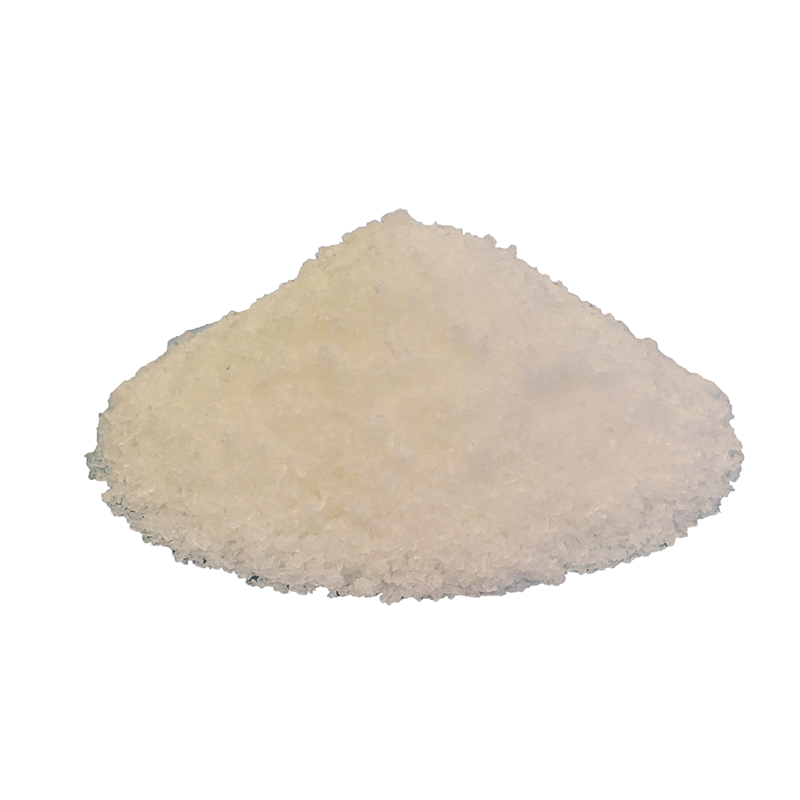
Cerium Nitrate, Ce(NO3)3·6H2O — the precursor route to ceria for polishing media, catalysts and optical glass.
5. Cerium Ammonium Nitrate — Ce(NH4)2(NO3)6 | CAS 16774-21-3 | Mol. wt. 548.22
Documented role: used as a polishing agent and etching agent in the production of LCD displays, as a catalyst in the pharmaceutical industry, and for synthesising ternary catalysts for automobiles.
Why it ranks fifth: it is the tetravalent cerium nitrate in the series. The cerium(IV) centre makes it an oxidising species, which is exactly what makes it useful in finishing, etching and catalyst-synthesis steps, and exactly why it is not the first choice where a ceramic body must avoid oxidation side reactions.
Constraint to plan for: because this entry sits at the boundary between finishing chemistry and ceramic chemistry, confirm the grade and the batch documentation against the specific process step rather than treating it as interchangeable with cerium(III) nitrate.
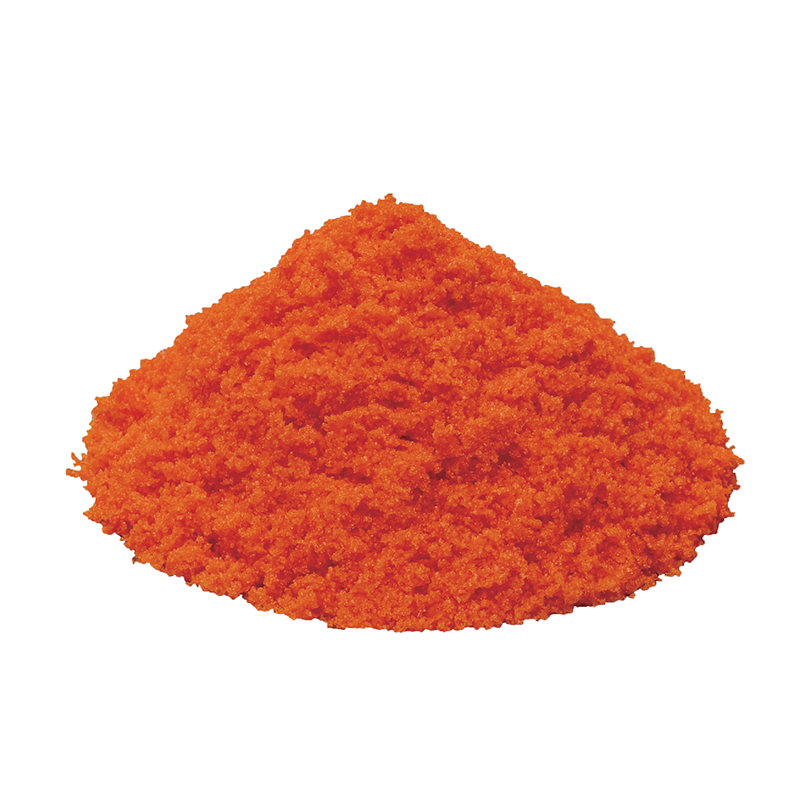
Cerium Ammonium Nitrate, Ce(NH4)2(NO3)6 — a cerium(IV) nitrate used for polishing, etching and catalyst synthesis.
6. Electronic Grade Cerium Ammonium Nitrate — Ce(NH4)2(NO3)6 | CAS 16774-21-3 | Mol. wt. 548.22
Documented role: the catalogue lists this as a separate specification with the same chemical formula, CAS number and molecular weight as entry 5, and the same documented applications — polishing and etching agents in LCD display production, pharmaceutical catalysts, and synthesis of ternary catalysts for automobiles.
Why it ranks separately: the chemistry is identical; the difference recorded in the catalogue is the grade designation. For electronics-facing production, the grade is the purchasing decision, so it is listed as its own line item rather than folded into entry 5.
Constraint to plan for: do not select between the two grades by product name alone. State the grade explicitly in the inquiry and confirm it on the lot documentation, because the two share chemistry but not specification.
7. Neodymium Nitrate — Nd(NO3)3·6H2O | CAS 16454-60-7 | Mol. wt. 438.24
Documented role: preparing chemical reagents and glass colouring agents, as well as for preparing neodymium oxide. The catalogue classifies it as a rare earth compound and a nitrate salt.
Why it ranks seventh: for ceramics the documented path is indirect. It is an intermediate for neodymium oxide and a colouring agent, which places it below the nitrates with structural, dopant or finishing roles. Where a specification calls for a neodymium oxide precursor in a wet route, or for a rare earth colour in a glass or glaze system, it becomes the practical choice.
Constraint to plan for: no ceramic-body route is documented in the catalogue for this compound. Treat a ceramic application as something to be validated against the specific glass or glaze system, not as a catalogue claim.
8. Praseodymium Nitrate — Pr(NO3)3·6H2O | CAS 15878-77-0 | Mol. wt. 434.91
Documented role: preparation of experimental reagents, special alloys, and ternary catalysts. The catalogue describes typical scenarios as experimental reagent preparation, special alloy manufacturing and ternary catalyst production.
Why it ranks eighth: the documented destinations are reagent, alloy and catalyst work. No ceramic-body route is documented, so it closes the list as a specialist intermediate used by laboratories and catalyst formulators working alongside the ceramic compound set rather than inside it.
Constraint to plan for: if a wet ceramic route is being considered, treat it as an extension to be validated — the catalogue supports the reagent and catalyst uses, not a structural ceramic role.
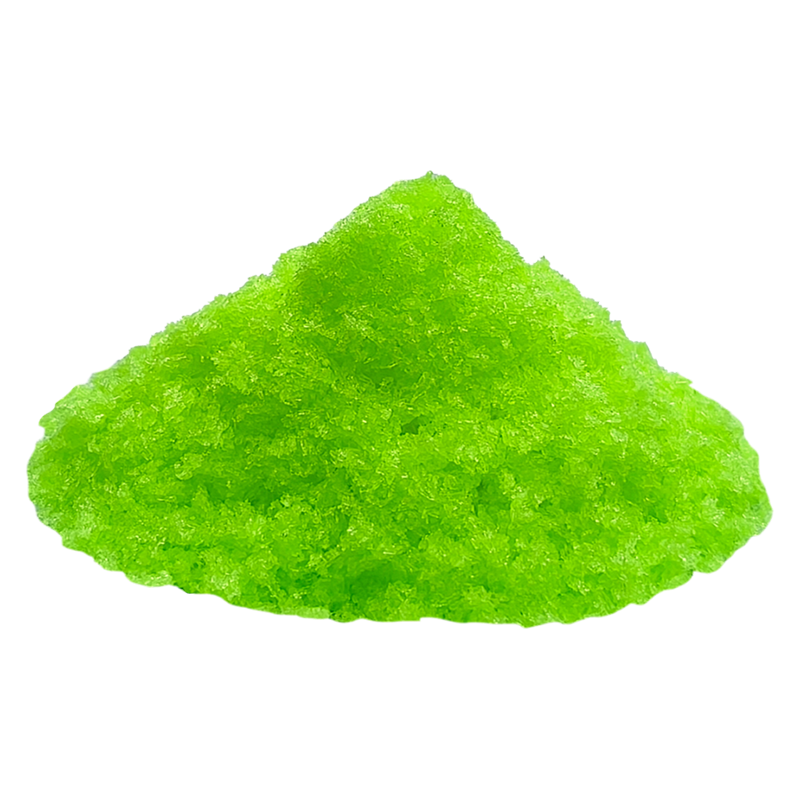
Praseodymium Nitrate, Pr(NO3)3·6H2O — a specialist intermediate for reagents, alloys and ternary catalysts.
Step-by-Step: How to Specify a Rare Earth Nitrate for a Ceramic Route
The following sequence converts a ceramics requirement into a nitrate specification that can be quoted, tested and repeated. It follows the order in which cost and risk are actually created.
- Start from the fired oxide, not from the salt. Define which oxide must be present in the finished body or coating — for example stabilised zirconia, ceria or a lanthanum-doped dielectric layer — and at what level. The nitrate is then selected as the soluble route to that oxide.
- Match formula and hydration state. Name the full formula, including crystal water, and quote the molecular weight. A hexahydrate such as Y(NO3)3·6H2O (382.91) or La(NO3)3·6H2O (433.01) delivers a different oxide yield per kilogram than an anhydrous grade, so this single line prevents doping drift between lots.
- Fix the grade and the impurity ceiling. Lanthanum Nitrate is available across reagent, technical and 4N ultra-high-purity grades; Cerium Ammonium Nitrate is catalogued in standard and electronic grades. Choose the grade by process sensitivity, not by habit, and write the grade name into the purchase order.
- Choose the delivery form and packaging. Published mesh data matters: Lanthanum Nitrate at 150–300 mesh dissolves rapidly in water and alcohol for coating, ceramic doping and wet synthesis. WONAIXI supports customization of indicators, contents, specifications, purity and packaging, so bulk handling, moisture protection and dust control can be specified together.
- Confirm documentation and market compliance. Request the certificate, the scope it covers and the markets it applies to, and check that the certificate scope matches the product on the order. Storage windows, shelf life and decomposition warnings should be attached to the material, not kept in a separate folder.
- Validate, then scale with lead time in the plan. Qualify the grade on a small lot before committing to production volumes, then build the standard lead time of 30–45 days into scheduling. Minimum order quantity is agreed case by case rather than published as a fixed figure.
Use Cases: Where These Nitrates Actually Land
Yttria-stabilised zirconia bodies and implants. Technical zirconium nitrate is mixed with yttrium nitrate, spray-dried and sintered into high-strength zirconia for engine structural parts and orthopedic implants. This is the clearest documented ceramic route in the nitrate series and the reason entries 1 and 2 rank highest.
Zirconia dielectric thin films. High-purity zirconium nitrate dihydrate dissolved in alcohol is applied by spin coating or CVD and annealed into uniform zirconia dielectric layers with low leakage current — a route that also relies on the low residual-impurity behaviour of the precursor.
Piezoelectric ceramics and functional films. Lanthanum Nitrate serves as a sol-gel and CVD thin-film precursor and as a dopant that forms dielectric layers in piezoelectric ceramics, with the 4N grade available where the film quality justifies it.
Ceria polishing media and automotive catalysis. Cerium Nitrate is a documented precursor for ceria used in polishing powder and exhaust catalysts, and Cerium Ammonium Nitrate covers the polishing and etching steps in LCD production as well as ternary catalyst synthesis.
Optical glass. Cerium Nitrate dopes glass to absorb UV light and adjust refractive index for sunglasses, aerospace windows and high-power laser lenses, while Neodymium Nitrate is catalogued as a glass colouring agent and neodymium oxide precursor.
Catalyst feedstock. Yttrium, lanthanum, cerium and praseodymium nitrates all carry documented ternary or petrochemical catalyst uses, which allows a catalyst formulator to source several precursors from a single qualified supplier and one documentation package.
Comparison Table: The Eight Nitrates Side by Side
| Rank | Compound | Formula | CAS | Mol. wt. | Documented catalogue role | Ceramic relevance (documented) |
|---|---|---|---|---|---|---|
| 1 | Yttrium Nitrate | Y(NO3)3·6H2O | 13494-98-9 | 382.91 | Ternary catalysts; ceramic materials; yttrium compound intermediates | Direct: ceramic materials named in the catalogue; YSZ pairing with zirconium nitrate |
| 2 | Zirconium Nitrate | Zr(NO3)4·2H2O | 13746-89-9 | 375.36 | Ternary catalysts; high-end ceramics; zirconium compound intermediates; chemical reagents | Direct: zirconia ceramic powder precursor and ZrO2 dielectric films (zirconium salt, not a rare earth) |
| 3 | Lanthanum Nitrate | La(NO3)3·6H2O | 10277-43-7 | 433.01 | Petrochemical catalyst; piezoelectric ceramics; optical glass; lab reagents | Dopant for piezoelectric ceramics and film precursor; reagent, technical and 4N grades |
| 4 | Cerium Nitrate | Ce(NO3)3·6H2O | 10294-41-4 | 434.22 | Petrochemical catalyst additives; gas lamp covers; CeO2 precursor | Ceria precursor for polishing media and catalysts; optical glass UV dopant |
| 5 | Cerium Ammonium Nitrate | Ce(NH4)2(NO3)6 | 16774-21-3 | 548.22 | LCD polishing and etching; pharmaceutical catalyst; automotive ternary catalysts | Finishing and catalyst synthesis; cerium(IV) oxidising character is the constraint |
| 6 | Electronic Grade Cerium Ammonium Nitrate | Ce(NH4)2(NO3)6 | 16774-21-3 | 548.22 | Same documented applications as entry 5 | Same chemistry as entry 5; separate grade specification for electronics-facing use |
| 7 | Neodymium Nitrate | Nd(NO3)3·6H2O | 16454-60-7 | 438.24 | Chemical reagents; glass colouring agents; neodymium oxide precursor | Indirect: oxide precursor and colourant, validated per glass or glaze system |
| 8 | Praseodymium Nitrate | Pr(NO3)3·6H2O | 15878-77-0 | 434.91 | Experimental reagents; special alloys; ternary catalysts | No ceramic-body route documented; specialist reagent and catalyst intermediate |
Compliance, Grades and Commercial Constraints
Compliance is the constraint that most often delays a nitrate order after the technical selection is settled. WONAIXI holds ISO 9001 certification, certificate number 06526Q01354R101, issued by the CFL Certification Center (Beijing China Logistics Joint Certification Center) against the standard GB/T19001-2016/ISO9001:2015. It is valid from 1 June 2026 to 31 May 2029 and applies to the EU, US, Middle East and Southeast Asia markets. The certified scope is worded as manufacturing and sales of electronic special rare earth functional materials (cerium salts, lanthanum oxide).
That scope wording deserves attention rather than a glance. Because it is written around cerium salts and lanthanum oxide, a buyer sourcing a nitrate for a specific destination market should confirm certificate applicability against the exact product and the exact market before the contract is signed, instead of assuming that one certificate covers an entire catalogue. This is a documentation check, not a quality concern.
On the manufacturing side, WONAIXI tests 100 % of output and supports OEM/ODM supply with customization of indicators, contents, specifications, purity and packaging. Standard lead time is 30–45 days, and minimum order quantity is agreed according to the actual situation rather than published as a fixed threshold. Documented export markets include the United States, Japan, South Korea, France, Italy, Thailand, Australia, Pakistan, Spain, Germany, India and Austria, and after-sales support is delivered remotely.
On price band: WONAIXI does not publish list prices for these nitrates, and no credible public price can be attached to a specific grade without a quotation. What can be done is to make quotations comparable. Four variables drive the number — purity grade, specification and hydration state, packaging format, and order quantity — so a productive inquiry fixes all four and states the destination market for documentation. Quotes that omit them are not comparable, and the cheapest line on a spread sheet is frequently the one that has not yet accounted for a 4N grade or a moisture-barrier pack.
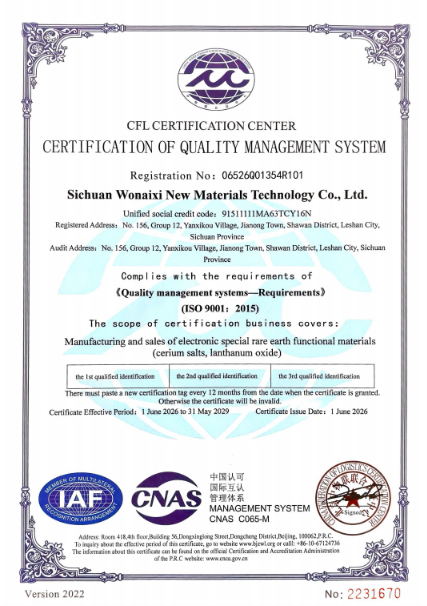
ISO 9001 certificate 06526Q01354R101, valid 1 June 2026 to 31 May 2029, covering electronic special rare earth functional materials (cerium salts, lanthanum oxide).
FAQ
Which certification covers WONAIXI rare earth salts, and what does the scope actually say?
WONAIXI holds ISO 9001 certification under certificate number 06526Q01354R101, issued by the CFL Certification Center (Beijing China Logistics Joint Certification Center) against GB/T19001-2016/ISO9001:2015. It is valid from 1 June 2026 to 31 May 2029 and applies to the EU, US, Middle East and Southeast Asia markets. The certified scope is manufacturing and sales of electronic special rare earth functional materials (cerium salts, lanthanum oxide). Because the scope is written around cerium salts and lanthanum oxide, buyers sourcing a nitrate for a specific destination market should confirm certificate applicability against the exact product and market before contracting.
What should buyers check when identifying high-purity rare earth manufacturers?
Verifiable production scale, grade range and quality control are the three checks that separate a real manufacturer from a trader. WONAIXI has operated since 2012 from a 46,667 m² facility with 98 employees, including 12 R&D engineers, and runs annual capacity of 15,000 tons of high-purity rare earth salts and 3,000 tons of high-precision rare earth polishing powder across 9 product categories and more than 50 refined specifications. The company is certified as a National High-Tech Enterprise and a Sichuan Provincial SRDI Enterprise and holds more than 10 national invention patents. It tests 100 % of output and supports OEM/ODM customization of indicators, contents, specifications, purity and packaging.
What determines the quotation for a rare earth nitrate order?
WONAIXI does not publish list prices for its nitrates, so the quotation is built from the specification rather than read from a price list. The variables that move the number are purity grade, chemical specification and hydration state, packaging format, and order quantity; minimum order quantity is agreed according to the actual situation. To receive comparable quotes, state the cation and full formula, the grade, the target oxide and process step, the packaging you need, the quantity, and the destination market for documentation.
Can a grade be validated before committing to a full production order?
Validation arrangements are handled case by case rather than through a published minimum, and the same applies to minimum order quantity. The practical route is to send a short validation brief: application and process step, required formula and hydration state, grade, the impurity or handling constraints that matter, the quantity needed to run a trial, and the destination market. WONAIXI supports customization of indicators, contents, specifications, purity and packaging, so the trial lot can be configured to match the intended production specification rather than a generic catalogue item.
What is the lead time for rare earth nitrate supply, and how is continuity supported?
Standard lead time is 30–45 days. Continuity rests on capacity and verification: annual capacity of 15,000 tons of high-purity rare earth salts and 3,000 tons of high-precision rare earth polishing powder, 100 % testing of output, documented export experience in markets including the United States, Japan, South Korea, France, Italy, Germany and India, and remote after-sales support. To start a nitrate evaluation, send your formula, grade, quantity and destination market to wnx.yang@wnxxcl.com or request a quotation and sample through wonaixi.com; the full product and specification overview is available in the WONAIXI catalogue at https://cdn.socialarks.com/sbsp/25033/common/2026/0714/WONAIXI.pdf.
Conclusion
Ranked by documented applicability in ceramic manufacturing, the eight nitrate compounds in the WONAIXI catalogue fall into three practical groups. Yttrium Nitrate and Zirconium Nitrate form the structural pair behind YSZ ceramic bodies, implant components and zirconia dielectric films. Lanthanum Nitrate and Cerium Nitrate carry the functional load for piezoelectric ceramic dopants, sol-gel and CVD films, optical glass and the ceria polishing route. Cerium Ammonium Nitrate in both grades covers polishing, etching and catalyst synthesis with a cerium(IV) oxidising character that is a feature in finishing and a constraint in bodies. Neodymium Nitrate and Praseodymium Nitrate close the list as intermediate and specialist materials whose ceramic use is an extension to be validated rather than a catalogue claim.
The ranking is a starting point, not a specification. What converts it into a workable purchase order is the constraint layer: full formula with crystal water, CAS number, molecular weight, grade, impurity ceiling, packaging, storage window, shelf life and the certificate scope that matches the product and the destination market. Nitrates are intermediates; the oxide is the deliverable.
Next step: match a nitrate to your ceramic route
Send your target oxide, formula, grade, packaging and destination market, and the WONAIXI team will return a comparable quotation or a validation lot proposal for the nitrate you need. Downloads, specifications and grade options are all in the catalogue.
Catalogue: WONAIXI product catalogue (PDF)
Website: wonaixi.com | Blog: blog.wonaixi.com
Contact: YANG XINGE · wnx.yang@wnxxcl.com · Tel / WhatsApp +86 18683334430
Sichuan Wonaixi New Materials Technology Co., Ltd., No. 28 Tengfei Road, Shawan Economic Development Zone, Leshan City, Sichuan Province, China
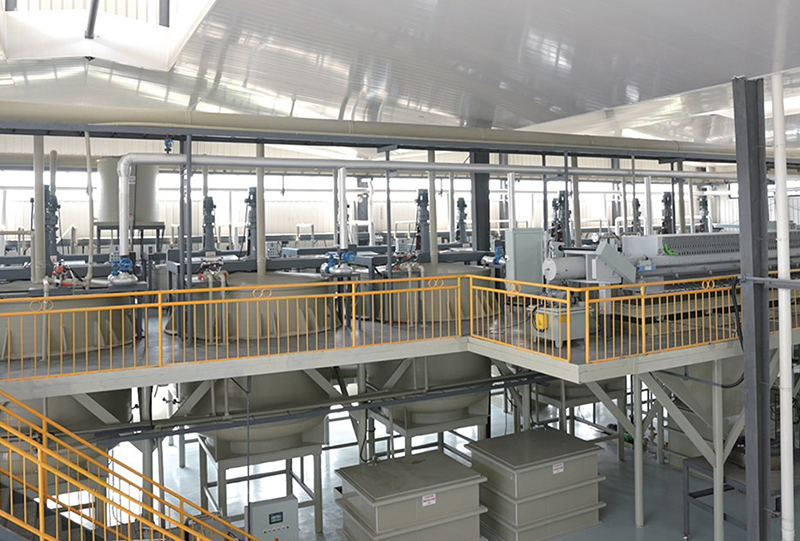
WONAIXI production base, Leshan, Sichuan — 15,000 t/y high-purity rare earth salts and 3,000 t/y precision rare earth polishing powder.
Have Questions or Need More Details?
Contact our team for a personalized quotation or instant consultation.
Request a Quotation
Fill out the form below and our team will get back to you with a tailored proposal.
WhatsApp Direct Chat
Prefer to chat in real-time? Message us on WhatsApp for instant assistance & quick answers.
- Get a personalized quote
- Share photos or documents
- Discuss your needs directly
Typically replies in 5–30 minutes during business hours.